

Executive Summary
Malaysia’s highly centralised federal system limits the fiscal and administrative tools available to state governments. In Penang, these constraints are particularly visible in areas such as social welfare and healthcare, where important resources, personnel and decision-making authority remain federally controlled.
Penang’s response has been to build governing capacity around the federal system, rather than wait for changes to take place. Over time, the state has mobilised specialised state-linked entities, civil-society expertise and local governments to create additional channels for policymaking and implementation.
These institutional adaptations have enabled Penang to exercise meaningful policy leadership despite limited formal authority. State-linked entities such as the Penang Women’s Development Corporation and Penang Green Council have developed and implemented programmes in areas ranging from gender-responsive budgeting to environmental sustainability, while Penang Global Tourism has supported state-level tourism development.
Local government provides another important source of state capacity. By drawing on professional local-government administrations and expanding their roles beyond conventional municipal services, Penang has used institutions already within state jurisdiction to advance wider priorities, including participatory budgeting, environmental sustainability, and active ageing.
Institutional innovation, however, is a complement to decentralisation—not a substitute for it. State-created institutions cannot overcome constraints where fiscal resources, statutory powers and administrative personnel remain federally controlled, particularly in healthcare and major infrastructure. The next phase should therefore combine stronger federal-state arrangements with continued consolidation, accountability, and sustainability of Penang’s own institutional innovations.
1. Overview
Malaysia operates a highly centralised federal system, with substantial fiscal and administrative authority concentrated at the federal level. While state governments are responsible for addressing many local development needs, their capacity to do so is shaped by comparatively limited revenue instruments and administrative authority.
These constraints have increasingly become part of the policy debate on federal-state relations. In 2025, the Penang State Legislative Assembly established the State-Federal Relations Select Committee to examine how existing federal arrangements affect the state’s development. Its work has covered fiscal and administrative governance, healthcare, and social welfare, contributing to broader debates on federal-state relations.
Yet institutional reform is necessarily a long-term process, while development challenges require immediate responses. Penang therefore presents an interesting case for the study of how a Malaysian state can expand its governing capacity within existing constitutional arrangements. Over time, the state has mobilised specialised state-owned entities, civil society partnerships and local governments to pursue policy objectives in areas such as economic development, tourism, environmental sustainability and active ageing. This paper examines these institutional adaptations and argues that while they can expand state capacity, they cannot fully be a substitute for administrative and fiscal reforms in areas where authority and resources remain concentrated at the federal level.
2. Penang: Governing Under Constraints
Since its establishment in 2025, the Penang State-Federal Relations Select Committee has provided an important platform for examining how Malaysia’s federal arrangements affect state development across a range of policy sectors, including fiscal governance, healthcare, and social welfare. While the discussions have covered diverse issues, they consistently point towards a common challenge: many implementation difficulties stem not from sector-specific shortcomings but from the broader institutional design of Malaysia’s federal system.
Penang’s fiscal position is constrained by both its limited revenue base and the broader architecture of Malaysian fiscal federalism. As the country’s second smallest state, Penang lacks the natural resource revenues available to many other states and relies heavily on non-tax sources, including licences, fees, dividends and land-related income, which accounted for approximately 57% of operating revenue in 2022[1].
At the same time, major tax instruments—including income, corporate, customs and excise taxes—are assigned to the federal government. Despite Penang’s substantial contribution to the national economy, its narrow own-source revenue base leaves it dependent on federal transfers for many development priorities[2].
Fiscal constraints are only one dimension of the challenge. Administrative authority is similarly centralised. Even in concurrent domains such as social welfare, frontline and senior welfare officers belong to the federal civil service, with appointments, transfers and promotions managed federally[3]. Although the state government is responsible for addressing many local development challenges, its ability to direct the personnel responsible for implementing policies remains limited.
The operation of Penang’s State Department of Social Welfare provides one example of how this divided administrative authority works in practice. While the department supports state welfare initiatives, it also administers federally funded programmes through personnel embedded within the federal civil service[4]. In practice, this creates overlapping lines of accountability between the federal and state governments, which may generate competing administrative priorities. Federal administrative requirements can consequently shape policy implementation in ways that limit the state’s ability to adapt welfare programmes to Penang’s specific social conditions[5].
These constraints have not prevented policy innovation, however. Since 2008, Penang has introduced state-funded initiatives such as iSejahtera, largely in areas where it retains direct discretion, including financial assistance and supplementary welfare schemes. More fundamental aspects of welfare governance—including personnel management, institutional service delivery, and the administration of national welfare programmes—remain closely tied to the federal administrative system. Similar concerns have been raised elsewhere; for example, Sarawak has sought greater administrative and financial autonomy over social welfare, arguing that decisions made from Putrajaya are often insufficiently responsive to local circumstances[6].
These constraints are more pronounced in predominantly federal domains such as healthcare. Although the state government works closely with hospitals and health authorities to improve healthcare outcomes, decisions regarding staffing, recruitment, deployment, and career progression remain centralized under the Ministry of Health (MOH), JPA and SPA. The state government has no formal authority to determine the number of doctors, nurses, or specialists allocated to Penang, nor can it introduce financial incentives to recruit or retain healthcare personnel because they remain federal employees[7].
This centralised personnel system limits the state’s ability to respond quickly to workforce shortages. Even where Penang identifies emerging healthcare demands, staffing and resource allocation remain determined federally, limiting the state’s ability to adjust healthcare capacity[8].
The consequences are increasingly visible. Public hospitals continue to experience significant workforce shortages as many doctors and specialists leave for the private sector, where remuneration and career progression are often more attractive. At the same time, bottlenecks in internship placements and specialist training—both managed centrally—delay the development of the public healthcare workforce. The result is a growing mismatch between healthcare demand and workforce capacity. Recent estimates indicate that approximately 58.8 per cent of medical specialists practise in the private sector, despite the public sector continuing to provide the majority of inpatient services[9].
Significantly, the call for reform is no longer confined to Penang. At the 2026 Inter-State Forum on State-Federal Relations held at Penang Institute, which is the secretariat for the select committee, representatives from Penang, Sarawak, Selangor, Kelantan, Terengganu, and Perlis all argued that Malaysia requires stronger and more institutionalised mechanisms governing federal-state relations. Rather than framing decentralisation as a partisan or state-specific demand, participants emphasised the need for a rules-based system that protects the interests of all states regardless of changes in political leadership. As Penang Chief Minister Chow Kon Yeow observed, “politicians and political parties come and go… but institutions remain.” [10] The challenge, therefore, is not merely to devolve additional powers, but to build durable institutions that enable states and the federal government to function as genuine partners in nation-building.
Despite these structural limitations, Penang has long been recognised as one of Malaysia’s leading states in economic development and governance. Although small in land area and population, Penang remains a significant contributor to the national economy, accounting for 7.6% of Malaysian GDP in 2024[11]. This raises an important question: how has the state managed to sustain policy innovation despite operating within one of the country’s most centralised administrative arrangements? The answer lies not in constitutional autonomy, but in the state’s ability to mobilise alternative institutions and governance mechanisms.
3. Penang’s Innovation
Penang’s reliance on alternative institutions is not new. During the administration of Lim Chong Eu[12], the Penang Development Corporation (PDC), established in 1969, became the state’s principal vehicle for industrialisation, land development and infrastructure planning. In its earlier years, PDC provided the state with considerable operational flexibility: the state government retained authority over board appointments and staff remuneration, allowing the corporation to develop its own professional workforce outside many of the personnel constraints associated with the conventional administrative system. This autonomy contributed to PDC’s effectiveness as a development institution during Penang’s industrial transformation. From the 1980s, however, greater federal oversight of state development corporations extended to borrowing, investment, staffing, post creation and budgets, gradually reducing this autonomy[13]. Nonetheless, PDC experience established an important precedent for Penang’s later approach to governance.
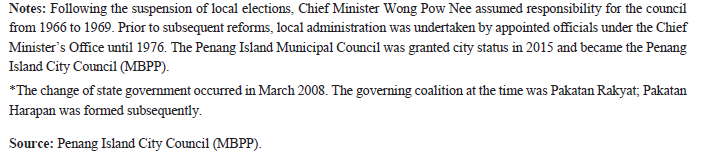
The change of state government in 2008 gave new impetus to this search for alternative mechanisms of policy delivery. In some areas, the new administration faced immediate capacity constraints[14]. In women’s development, for example, the withdrawal of federal personnel and funding had left the state with limited resources to sustain existing programmes[15]. Penang, however, had a long-established and active civil society, with organisations working in areas ranging from women’s rights and environmental protection to heritage conservation. This provided the state with an existing pool of expertise and community networks that could be drawn into policymaking and programme delivery. Women’s organisations worked closely with the state government on initiatives such as Gender Responsive Participatory Budgeting (GRPB), while NGO representatives were appointed as local councillors and to advisory bodies such as the Penang Transport Council, which contributed to the development of the Penang Transport Master Plan[16].
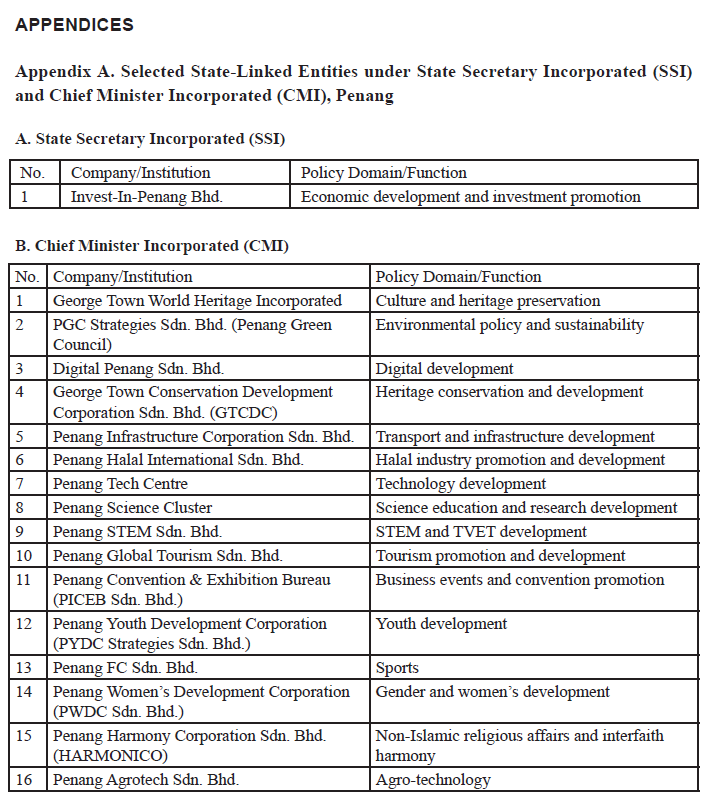
As these collaborations matured, the state institutionalised them through specialised government-linked companies (GLCs) and state agencies. Incorporated under the Companies Act rather than forming part of the conventional civil service structure, these entities provided the state with greater flexibility over staffing, budgeting and stakeholder engagement while remaining under state ownership and oversight. The Penang Women’s Development Corporation (PWDC), established in 2011, institutionalised earlier civil-society engagement on gender equality and subsequently assumed substantial policy-development and implementation roles, including the Safe Family Policy, Gender Responsive and Participatory Budgeting, and the Age-Friendly City initiative. Similar arrangements emerged in other policy domains. The Penang Green Council, for example, has played a central coordinating and implementation role in Penang’s long-running campaign against single-use plastics[17]. Rather than functioning primarily as commercial enterprises, these entities have become specialised policy-delivery institutions through which the state develops, coordinates and implements programmes within existing constitutional arrangements[18].
Such arrangements also enabled Penang to develop complementary capacity in areas where important policy levers remained at the federal level. Tourism provides one example. Although international promotion, immigration and aviation are substantially shaped by federal policy, Penang has developed its own destination branding and tourism ecosystem through Penang Global Tourism, alongside local-government efforts in heritage conservation, placemaking, festivals and cultural programming. These efforts have coincided with strong international tourism performance: Penang recorded 967,742 international hotel guests in the first quarter of 2026, ranking third nationally behind Kuala Lumpur and Selangor according to Tourism Malaysia’s Paid Accommodation Survey[19]. These outcomes do not only demonstrate the effects of state intervention, but also illustrate the scope for state-level policy leadership within a broader federal framework.[20]
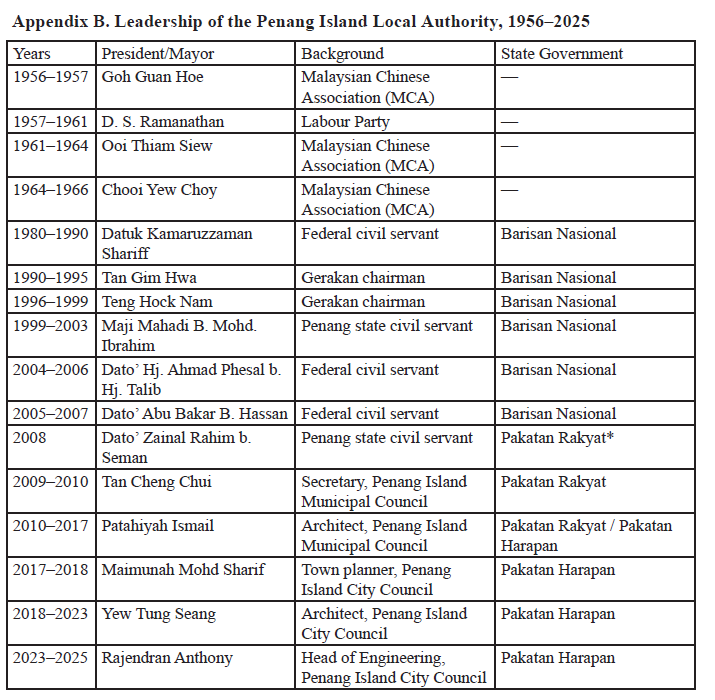
While specialised state agencies expanded implementation capacity in selected policy areas, Penang also increasingly relied on another institution already within its constitutional authority—local government. Local government falls under the State List, and its personnel system gives the state considerably greater influence than it possesses over federally staffed state departments. Penang sought to use this institutional space by professionalising local administration. The practice of appointing politicians as mayors was discontinued in favour of promoting career local-government officials with relevant professional and administrative experience since 2008[21]. Maimunah Mohd Sharif, a town planner who served as President of the Seberang Perai Municipal Council before becoming Mayor of the Penang Island City Council (MBPP), exemplified this approach.
The state also had greater scope to recognise and reward performance within the local-government system, including through career advancement and state honours. As local-government officers generally build their careers within the councils rather than through rotation in the federal service, this provides greater administrative continuity and enables more sustained working relationships with MBPP and the Seberang Perai City Council (MBSP). Over time, this relationship enabled the councils to take on roles extending beyond conventional municipal services. Local governments became important implementation partners for broader state priorities, including Gender Responsive Participatory Budgeting (GRPB), environmental sustainability and, more recently, the Age-Friendly City agenda.
One of the clearest examples is Penang’s Age-Friendly City initiative, with Penang Island becoming the first city in Malaysia to complete the World Health Organization’s (WHO) Age-Friendly Cycle. Implemented through MBPP, the initiative addresses ageing through areas within local-government jurisdiction, including accessibility, public spaces and community participation. Its programmes have produced tangible outcomes: the Public Sanitation Maintenance Programme provides older adults and retirees with opportunities for continued participation; more than 550 environmental health activities have been conducted; and approximately 1,000 people have been trained to use Automated External Defibrillators (AEDs).[22] The recurring Zero Burden[23] similarly promotes intergenerational participation through community activities. Together, these initiatives demonstrate how local government can translate an age-friendly agenda into sustained programmes[24].
Together, these experiences demonstrate that Penang has progressively built a governance model centred on institutional collaboration. Rather than relying solely on conventional state departments, policy implementation increasingly occurs through a network of specialised agencies, local governments, civil society organisations and professional communities. This institutional flexibility has enabled the state to pursue policy innovation despite operating within a highly centralised federation.
4. The Limits of Institutional Innovation
Penang’s experience demonstrates that institutional innovation can expand state capacity within existing constitutional arrangements. Through specialised state entities, partnerships with civil society and local governments, the state has created additional avenues for policy implementation. Yet these adaptations have clear limits where fiscal resources, statutory authority and administrative personnel remain centrally controlled.
Healthcare provides perhaps the clearest example. While the state government can complement healthcare delivery through preventive health programmes, community initiatives and age-friendly urban planning, the core healthcare system—including hospitals, workforce planning, specialist training and personnel management—remains under the authority of the federal government. As discussed earlier, Penang cannot determine the number of doctors, nurses or specialists assigned to the state, nor can it independently introduce incentives to recruit or retain healthcare professionals because they remain federal civil servants, which has led to manpower gaps at times[25]. Consequently, even where the state identifies local needs or is willing to invest additional resources, its ability to improve healthcare delivery ultimately depends on cooperation with federal institutions.
Major infrastructure presents a similar constraint. As discussed earlier, Penang has sought to expand its implementation capacity by making greater use of local governments in areas within their jurisdiction. Yet the effectiveness of this strategy diminishes as the scale and regulatory complexity of projects increase. The State-Federal Relations Select Committee highlights how major infrastructure projects, particularly public transport, remain dependent on federal regulatory approval and financial support, while the state’s narrow revenue base and borrowing constraints limit its capacity to independently finance capital-intensive projects[26]. Consequently, although local governments can undertake planning and local improvements, they cannot substitute for federal authority and resources in delivering large-scale transport, flood mitigation and other major infrastructure projects.
Institutional adaptation also creates challenges of its own. As Penang’s specialised GLCs mature, questions have emerged over financial sustainability and potential duplication with conventional government agencies. These concerns have also been raised within the state: PKR assemblyman Lee Khai Loon called for the rationalisation of GLCs with overlapping functions, while a senior civil servant similarly questioned whether some activities require separate institutional structures[27]. By 2025, the state government had begun responding to these concerns, with Chief Minister Chow Kon Yeow announcing plans to consolidate entities with overlapping functions and encourage greater diversification of revenue sources[28].
Their evolution also raises questions about civic participation. Civil society contributed to Penang’s earlier institutional innovations, with some expertise being subsequently incorporated into state-owned entities. While this strengthened implementation capacity, preserving independent channels for participation, scrutiny and policy feedback remains important.
Penang’s experience ultimately suggests that institutional innovation and decentralisation are complementary rather than competing strategies. States can creatively maximise the constitutional space already available to them, but they cannot independently resolve challenges where authority, personnel and resources remain concentrated at the federal level. This broader concern increasingly extends beyond Penang. At the 2026 Inter-State Forum on State-Federal Relations, representatives from states across different political coalitions called for stronger rules-based federal-state institutions that can endure changes of government.
The next phase of Malaysian federalism should therefore build on state-level innovation while developing a more durable institutional partnership between federal and state governments.
- Penang Institute Statistics. (n.d.). Operating Revenue. Penang Institute. Retrieved 6 August 2026, from https://statistics.penanginstitute.
org/dashboards/sector/finance.html ↩ - Gooi, H. L. (2025). Report of the Penang State-Federal Relations Select Committee 01/25. Presented at the Penang State
Legislative Assembly, December 8, 2025.↩ - Abdullah Sanusi Ahmad, Norma Mansor, and Abdul Kuddus Ahmad (2003), The Malaysian Bureaucracy: Four Decades of
Development. Selangor: Pearson Prentice Hall. ↩ - In Penang, frontline social workers and senior welfare officers are members of the federal civil service, with appointments,
transfers, and promotions managed by the Public Service Department (JPA) and the Public Service Commission (SPA). ↩ - Farrah Shameen Binti Mohamad Ashray. (2018). Social welfare services in Malaysia: The role of government. In Asian
Association for Public Administration Annual Conference (AAPA 2018), Advances in Social Science, Education and Humanities
Research, 191, 427–436. Atlantis Press. ↩ - Ibid. ↩
- Khor, S. K. (2024). Sustainability and Resilience in the Malaysian Health System. Taipei: Center for Asia-Pacific Resilience
and Innovation (CAPRI). ↩ - Mohd Tahir, A., Li, S. C., & Thomas, P. (2014). PHP107 challenges and opportunities in the Malaysian health care system.
Value in Health, 17, A802. ↩ - Thomas, S., Beh, L. S., & Nordin, R. B. (2011). Health care delivery in Malaysia: Changes, challenges and champions.
Journal of Public Health in Africa, 2, e23. https://doi.org/10.4081/jphia.2011.e23. ↩ - Mok, O. (2026, June 11). Politicians come and go, institutions remain: Leaders call for stronger federal-state framework.
Malay Mail. Retrieved 6 August 2026, from https://www.malaymail.com/news/malaysia/2026/06/11/politicians-
come-and-go-institutions-remain-leaders-call-for-stronger-federal-state-framework/223339 ↩ - The Star. (2026, June 26). Penang primed to prosper. Retrieved 6 August 2026, from https://www.thestar.com.my/business/
business-news/2026/06/26/penang-primed-to-prosper ↩ - Lim Chong Eu served as Chief Minister of Penang from 1969 to 1990 and played a central role in the state’s industrialisation strategy, including the establishment of the Penang Development Corporation. ↩
- Hutchinson, F. E. (2008). “Developmental” states and economic growth at the sub-national level: The case of Penang. In Southeast Asian Affairs 2008 (pp. 223–224). ISEAS–Yusof Ishak Institute. ↩
- The 2008 general election ended Barisan Nasional’s (BN) long-standing rule in Penang and brought the Pakatan Rakyat (PR) coalition to power. This also changed Penang’s relationship with the federal government: the state was now governed by an opposition coalition while BN remained in power federally. PR was subsequently succeeded by Pakatan Harapan (PH), which continued to govern Penang. ↩
- Ng, C. (2012, February). Right time, right place, and some luck: PWDC in the making. Penang Monthly, 18–20. ↩
- Chan, X. Y., Weiss, M. L., & Yeoh, T. (2024). The business of governing Penang: Workarounds as remedy? Journal of Current Southeast Asian Affairs, 43(2), 331–354. https://doi.org/10.1177/18681034241262041 ↩
- Avrasan, N. (2018, February 9). Penang’s move to reduce plastic waste laudable. Malaysiakini. Retrieved August 10, 2026, from https://www.malaysiakini.com/letters/411711 ↩
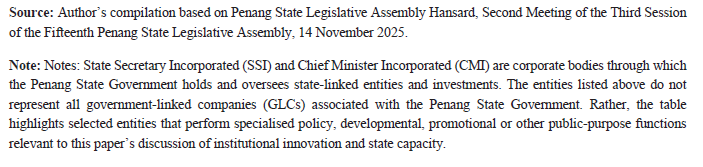
- See Appendix A for a list of selected state-linked entities under the State Secretary Incorporated (SSI) and Chief Minister Incorporated (CMI) and their respective policy functions. ↩
- Mok, O. (2026, August 6). Penang ranks third in international hotel guests, recording nearly one million visitors in Q1 2026. Malay Mail. Retrieved August 10, 2026, from https://www.malaymail.com/news/malaysia/2026/08/06/penang-ranks-third-in-international-hotel-guests-records-nearly-one-million-visitors-in-q1-2026/230406 ↩
- Tourism rankings vary according to the indicator and methodology used. DOSM’s domestic tourism statistics ranked Penang considerably lower based on domestic visitor estimates, a finding subsequently disputed by the Penang state government, which pointed to Tourism Malaysia’s hotel-stay records as an alternative measure of tourism performance. The figures used here refer specifically to hotel-stay records and should not be interpreted as Penang’s overall ranking across all tourism indicators. New Straits Times, “Penang Defends Tourism Performance Following DOSM Domestic Visitor Ranking,” July 2026. ↩
- See the list of Mayors/Presidents of the Penang Island Municipal/City Council (1956-current) in Appendix B. ↩
- Automated External Defibrillators (AEDs) are portable devices used to respond to sudden cardiac arrest by analysing heart rhythm and, when necessary, delivering an electric shock. Rapid access to an AED is particularly important because the likelihood of survival decreases substantially every minute that defibrillation is delayed. Making AEDs accessible in public spaces and training community members to use them therefore strengthens community emergency preparedness, particularly for populations at greater risk of cardiac emergencies. ↩
- The Zero Burden Bazaar is a monthly community event in Penang that brings together residents of all ages, including children, adults, and seniors. It uses market-based and lifestyle activities to promote healthy living and active ageing while strengthening social bonds across generations. The programme is part of a broader effort to ensure older residents feel valued, respected, and included in their community. ↩
- Kaur, S. (2025). Age-Friendly City: Penang Island (AFCPI) Initiative Evaluation Report (2023–2025). Prepared for Malaysian Healthy Ageing Society (MHAS), Majlis Bandaraya Pulau Pinang (MBPP), and Penang Women’s Development Corporation (PWDC). ↩
- R. Sekaran. 20 November 2025, Penang to add more clinics, health facilities under 13MP to cope with congestion. The Star. https://www.thestar.com.my/news/nation/2025/11/20/penang-to-add-more-clinics-health-facilities-under-13mp-to-cope-with-congestion ↩
- Gooi, H. L. (2025). Report of the Penang State-Federal Relations Select Committee 01/25. Presented at the Penang State Legislative Assembly, December 8, 2025. ↩
- Ragu, D. (2021, December 3). Why do you need more GLCs, Penang backbencher questions govt. Free Malaysia Today. Retrieved August 10, 2026, from https://www.freemalaysiatoday.com/category/nation/2021/12/03/whydo-you-need-more-glcs-penang-backbencher-questions-govt ↩
- Chan, X. Y., Weiss, M. L., & Yeoh, T. (2024). The business of governing Penang: Workarounds as remedy? Journal of Current Southeast Asian Affairs, 43(2), 331–354. https://doi.org/10.1177/18681034241262041 ↩
You might also like:
![Reducing Moral Hazards in Malaysia’s Public Healthcare System]()
Reducing Moral Hazards in Malaysia’s Public Healthcare System
![Tighter Collaboration Needed in Penang’s Skills Development Infrastructure]()
Tighter Collaboration Needed in Penang’s Skills Development Infrastructure
![ESG Disclosures among Public-listed Companies Based in Penang]()
ESG Disclosures among Public-listed Companies Based in Penang
![Eradicating Child Marriages in Southeast Asia: Protecting Children, Challenging Cultural Exceptional...]()
Eradicating Child Marriages in Southeast Asia: Protecting Children, Challenging Cultural Exceptional...
![Protecting Women: An Overview of Women’s Legal Rights in Southeast Asia]()
Protecting Women: An Overview of Women’s Legal Rights in Southeast Asia