

Executive Summary
- Penang’s economic strength relies heavily on its traditional MSMEs (Micro, Small, Medium Enterprises), especially in manufacturing, and on a growing tech startup ecosystem. However, despite their importance to global supply chains and local innovation, both groups share a common structural weakness: they consistently struggle to secure the capital needed to grow.
- When local businesses attempt to scale, they hit a funding wall. Startups often run dry on cash before their products become profitable, forcing founders to rely entirely on personal savings. Meanwhile, mature MSMEs find it difficult to secure the mid-tier financing required to move from day-to-day survival into long-term expansion.
- The funding blocks come from both sides of the market. Traditional banks demand physical collateral, which automatically disqualifies asset-light tech startups. For traditional MSMEs, rising costs and low productivity are eating into their profit margins, making them look risky for bank loans. Furthermore, local venture capitalists (VCs) prefer to play it safe, often ignoring early-stage ventures to invest in already-profitable enterprises.
- National policies under Budget 2026 and RMKe-13 are actively shifting away from outdated grant models toward sustainable financing. The government is expanding guarantee schemes (like SJPP and BSN) so businesses can secure loans without physical collateral. Additionally, initiatives like SARANA use P2P platforms to help firms turn unpaid invoices into immediate cash, while new IP collateralization projects will finally allow tech startups to use their patents to get funding.
A Review of Micro, Small, Medium Enterprises and Startups Financing in Penang
By Siti Nor Nadhirah & Kenneth Ong Kar Sheng (Project Researcher, Socioeconomics & Statistics Programme)
1. Overview
Penang’s reputation as the “Silicon Valley of the East” is well-earned. While multinational corporations often dominate the economic narrative, the true anchor of the state’s resilience lies in its dense network of MSMEs and its rapidly maturing startup ecosystem. These enterprises support vital global supply chains and pioneer digital innovations. Yet, beneath this surface of economic vitality, local founders and business owners face a systemic vulnerability: a persistent inability to secure the capital required to scale their operations.1
The core issue is a structural financing gap. When local businesses attempt to transition from basic survival to long-term expansion, whether a manufacturer automating its factory floor or a tech founder commercializing new software, they frequently encounter a financial impasse. Development economists identify this as the classic “missing middle”.2
On one end of the spectrum, traditional commercial banks rely on rigid, collateral-based lending, effectively locking out asset-light or highly innovative companies. On the other end, local private equity and venture capital markets remain highly risk-averse, often preferring to fund mature, profitable businesses rather than taking a chance on early-stage ventures.
This capital mismatch is exacerbated by friction on both the demand and supply sides of the market. For business owners, rising operational overheads and a stubborn disconnect between wages and productivity erode profit margins and leave them with balance sheets that struggle to attract commercial lending. In response to the retreat of private capital, the government has stepped in as the primary funder. However, relying heavily on state-led capital introduces its own challenges. Research indicates that extensive government involvement often comes with administrative bottlenecks and can inadvertently distort the market, crowding out private investors that need a supportive ecosystem to thrive.3
If Penang is to sustain its competitive advantage in global value chains, addressing this financing bottleneck is an political imperative. This paper systematically maps the financing lifecycle of local MSMEs and startups to pinpoint places where capital flows stall. It examines the specific demand and supply-side barriers hindering growth, and critically evaluates current government interventions, particularly those within Budget 2026 and the 13th Malaysia Plan (RMKe-13), to assess how national policy is pivoting toward a more sustainable, market-driven funding landscape.
2. Profiling MSMEs and Startups
Before examining the financing gaps, it is crucial to understand the landscape of the enterprises driving the local economy. While traditional MSMEs and tech-driven startups operate with different business models, together they form the backbone of Penang’s economic resilience and capacity for innovation.
2.1 The backbone of the economy: MSMEs profile and performance
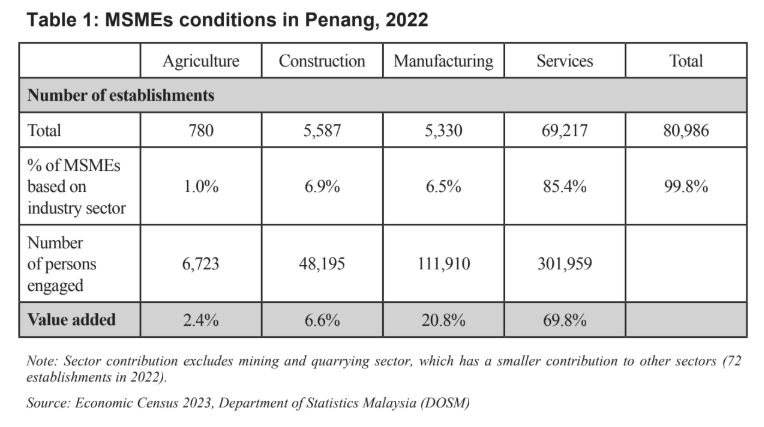
At the national level, MSMEs remain a cornerstone of Malaysia’s economy, contributing nearly 40% to the GDP, accounting for 65.2% of total employment, and making up 98% of all business establishments. Within this national framework, Penang holds a strategic weight, housing approximately 7.9% of Malaysia’s total MSMEs.
A closer look at 2022 data reveals a distinct economic structure in the state. While the Services sector dominates in terms of sheer numbers (85.4% of establishments), the Manufacturing sector is the core driver of economic output. Despite making up only 6.5% of MSME establishments, manufacturing contributes a disproportionately high 20.8% to the state’s MSME value added. These manufacturing MSMEs play an indispensable role in supporting the global supply chains of Penang’s renowned electronics and electrical (E&E) ecosystem, as well as food processing and engineering services.
2.2 The innovation engine: Startup landscape and funding profile
In parallel with the traditional MSMEs sector, the startup ecosystem is rapidly gaining ground. Nationally, Malaysia’s startup ecosystem was valued at RM20 billion between 2022 and 2024. In 2024 alone, over 5,000 active startups collectively raised RM553 million, backed by a network of around 1,000 investors.4 While Kuala Lumpur traditionally leads the nation, particularly in fintech, where it ranks in the top 16 globally,5 Penang is aggressively carving out a distinct niche in advanced technologies, particularly in IC design, marketing tech, and agritech.
In 2025, Penang’s startup ecosystem experienced a remarkable 40% annual growth rate,6 positioning itself as a high-tech innovation hub. Leveraging its legacy as the “Silicon Valley of the East,” local founders are building ventures rooted in advanced technologies, hardware, and specialized e-commerce.
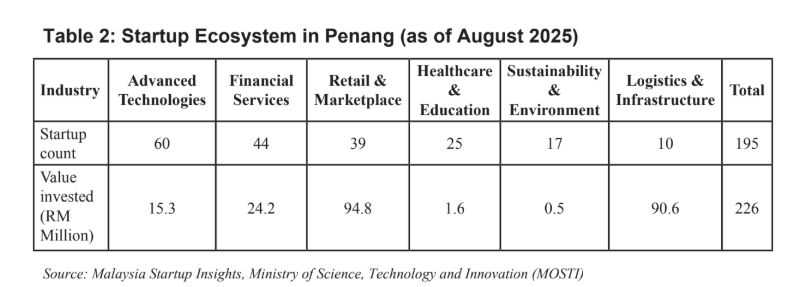
However, a breakdown of local startup funding reveals an interesting disparity. As shown in Table 2, while Advanced Technologies forms the largest cluster by startup count (60 startups), it has only secured a fraction of the capital (RM15.3 million). Instead, the bulk of investment capital has flowed into Retail & Marketplace (RM94.8 million) and Logistics & Infrastructure (RM90.6 million). This indicates a significant funding mismatch: investors are favouring consumer-facing platforms with faster returns over the deep-tech ventures that require longer incubation periods.
Despite their outsized economic contributions and different risk profiles, both traditional MSMEs and innovative startups eventually hit a similar structural wall. To move from mere survival to long-term scaling, both enterprise types require access to sustainable, diversified financing. Understanding how these companies are funded as they mature is the first step to diagnosing the gaps in the market.
3. Financing Lifecycle for MSMEs and Startups
Analyzing the financing gap requires a closer look at the firm’s lifecycle. Business capital needs are different at different stages of maturity. While a traditional MSME and a tech-driven startup have different risk profiles, both inevitably run into identical structural roadblocks during critical growth phases.
3.1 Early stage: The seed gap and self-financing trap
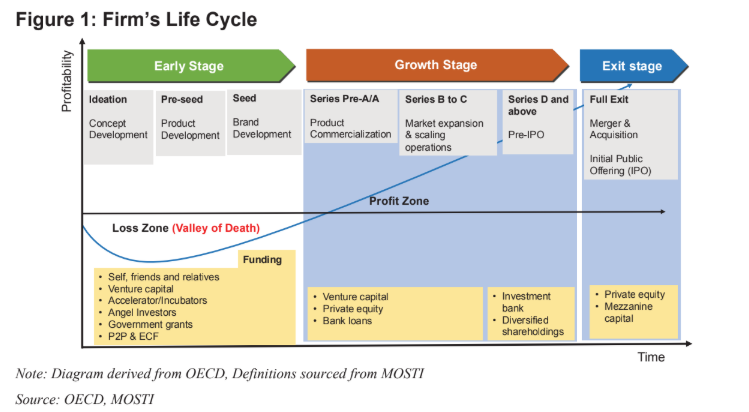
In their earliest days, spanning concept development to the seed stage, new ventures typically fall into the “Valley of Death” (see Figure 1). This is a highly precarious period where founders burn through cash for R&D and daily operations, long before they can generate meaningful revenue.
In a mature ecosystem, this gap is usually bridged by angel investors, early-stage venture capital, or government grants. However, the reality for most local enterprises is starkly different; they often find themselves stuck in a “Self-Financing Trap”.
- Heavy reliance on personal savings: Data from the OECD (2024) reveals that 74% of funding for firms under six years old still comes from “own cash” which is essentially retained earnings or money borrowed from family and friends.
- Marginalized equity funding: Risk-capital instruments like Venture Capital (VC) or Equity Crowdfunding (ECF) remain severely underutilized, making up less than 5% of early-stage funding.
Because the local market lacks a deep network of angel investors, founders are forced to drain their personal savings just to keep the lights on. This exhaustion of internal capital creates a dangerous ripple effect. It strips away their financial buffer, delays crucial technological upgrades, and ultimately compromises the state’s broader competitiveness in the global value chain.
3.2 Growth stage: The ‘missing middle’ and collateral barriers
If a firm survives to the Growth Stage (typically Series A to C), its focus shifts to product commercialisations and scaling up operations. This requires substantial capital. Unfortunately, this is exactly where the “Missing Middle” gap becomes glaringly obvious, highlighting a disconnect between traditional banking criteria and the realities of modern business.
- Uneven loan distribution: While total outstanding MSMEs loans in Malaysia reached an impressive RM355 billion in 2022, the distribution is heavily skewed. Nearly 75% of these funds are concentrated in loans exceeding RM1 million. Essentially, commercial banks prefer to lend to established “Medium” enterprises, leaving smaller, expanding firms starved of growth capital.
- The physical collateral trap: Growing MSMEs are consistently blocked by a rigid, collateral-centric banking system. Nearly half (50%) of the MSMEs that successfully secured loans were required to pledge physical collateral, such as land or property, often covering up to 55% of the loan value.7
- The “unbankable” startup: This collateral requirement is particularly punishing for high-tech startups, whose core value lies in intangible assets like software code, algorithms, and patents. Because traditional banks struggle to underwrite these assets and typically only lend to businesses already operating safely in the “Profit Zone”, highly innovative firms are left without the debt financing needed to scale.
4. Structural barriers to financing: a demand and supply assessment
4.1 The demand-side dilemma: Why MSMEs struggle to attract capital
Demand 1: The profitability squeeze and weak balance sheets
The rising cost of doing business driven by more expensive raw materials, higher electricity tariffs, and a fierce war for skilled talent is severely squeezing profit margins for MSMEs in economic hubs like Penang. As overheads pile up, internal capital pools drain quickly. Recent assessments by Bank Negara Malaysia (BNM) warn that these elevated input costs heavily erode the cash buffers of smaller enterprises, leaving them highly exposed to supply-chain disruptions and broader economic shocks.8
This financial squeeze forces business owners into a purely defensive mode. Instead of reinvesting earnings into capacity expansion or much-needed technological upgrades, MSMEs have to prioritize day-to-day survival and immediate cash flow stability. It is a common pattern: when smaller firms face prolonged cash constraints, they routinely delay long-term capital expenditures, which severely stunts their ability to scale and move up the firm life cycle.9
At the end of the day, this heavy burden of overheads directly hurts a firm’s “investment readiness.” MSMEs often approach the capital market with fragile balance sheets, irregular earnings, and poor financial documentation. Without healthy working capital, it becomes nearly impossible for these businesses to meet the strict debt-service ratios, track records, and physical collateral requirements that commercial banks demand. In the eyes of traditional lenders, they become structurally “unbankable”.10
Demand 2: The wage-productivity mismatch
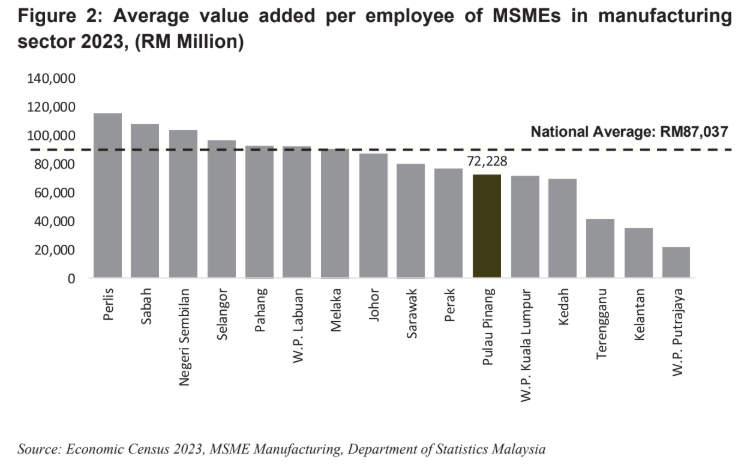
While Penang’s manufacturing sector is known for paying competitive wages, these higher labor costs are not always matched by actual value creation. The value added per employee still lags significantly behind the national average. When value-added output remains low, business struggle to generate the revenue needed to comfortably absorb operational costs or support meaningful wage increases. This productivity gap points to a lingering reliance on labour-intensive models and a slow adoption of new technology, both of which put extra strain on already tight operating margins.
For lenders and investors, this imbalance between wages and productivity is a major red flag. With shrinking cash flows, MSMEs struggle to produce the solid financial statements required to prove they can safely service new debt. As a result, financial institutions hesitate to lend, fearing that any new capital injected will simply go toward subsidizing daily operational inefficiencies rather than generating real productivity gains and returns.
4.2 The supply-side bottleneck: Why capital isn’t reaching business owners
Supply 1: Lack of private investment impedes the growth of early-stage startups
Private equity is essential to help early-stage startups survive the pre-revenue “valley of death”. Unlike traditional lenders, equity investors bring risk-tolerant capital into play, alongside strategic mentorship. However, Malaysia’s startup ecosystem suffers from a highly risk-averse culture that tends to push private venture capital (VC) toward much safer, established businesses. This caution is especially obvious among local corporate venture capital (CVCs). Rather than taking a chance on seed funding, they usually prefer to back mature businesses that are already well into their growth stages.11
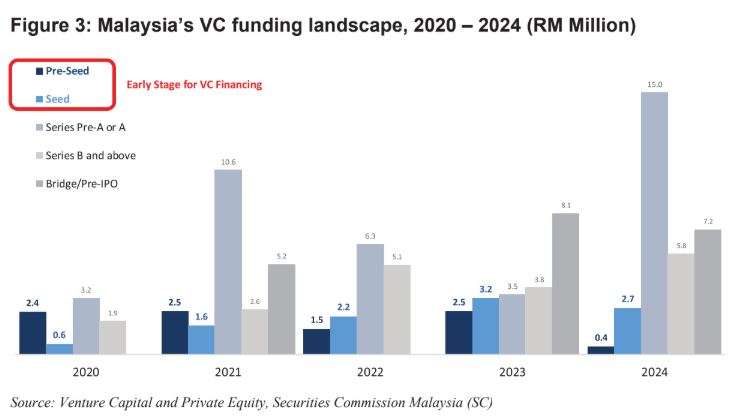
This “flight to safety” is painfully clear when we look at where the money actually goes. Typically, a pre-seed round requires under RM500,000, while seed capital ranges between RM500,000 to RM5 million.12 Yet the average VC funding for pre-seed startups shrank to just RM400,000 in 2024. At the same time, later-stage companies are seeing a massive influx of cash, with Series Pre-A startups taking home an average of RM15 million well above standard Series A benchmarks. This widening gap shows that investors are increasingly losing their appetite for risk, choosing instead to bet on proven profitability while starving early-stage founders of the capital they need to get off the ground.
Supply 2: Public sector intervention and the challenges of state-led capital
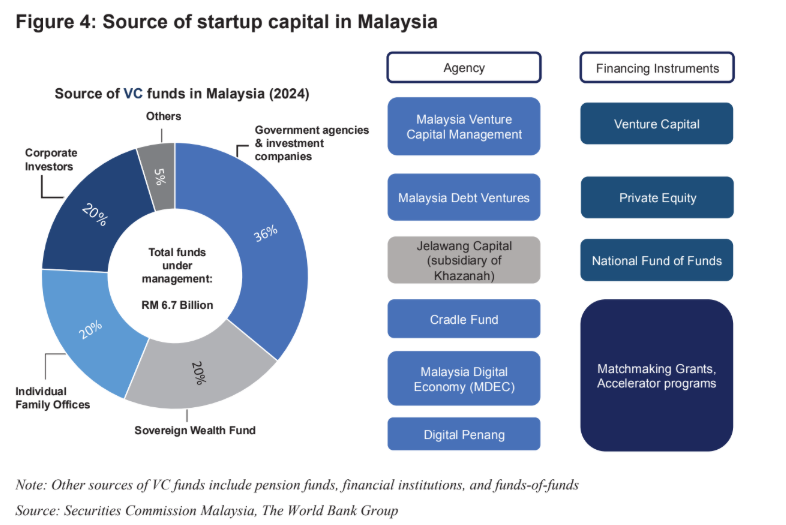
As private capital shies away from risky early-stage ventures, the government inevitably steps in as the “lender of last resort”. Today, a wide safety net is managed by various federal and state agencies, including Cradle, MDEC, MAVCAP, and Digital Penang. Together, they try to plug the funding gap through tech grants, matchmaking funds, and specialized debt programmes designed to keep the ecosystem moving.
However, even with this massive support system in place, state-led funding is often bogged down by heavy bureaucracy and a lack of coordination between ministries. More importantly, a survey by the Institute for Capital Market Research Malaysia (ICMR) pointed out a critical flaw: founders frequently feel that government-managed VCs lack the deep, specialized industry expertise needed to properly assess complex tech investments.13 Because of this administrative friction, startups end up losing precious time waiting for approvals when they should be focusing on growth.
There is also a bigger macroeconomic issue at play: the sheer dominance of state funds. In 2024, the public sector managed over half of all VC funds in Malaysia. When the government acts as a direct shareholder, it unintentionally competes with private VCs. These dynamic risks distort the market and actually scare away private investors who might otherwise participate.14 For the ecosystem to truly thrive on its own, government agencies need to shift from being direct competitors to being behind-the-scenes enablers. A practical step would be to strategically channel public money into national Funds of Funds (FoF) aimed at crowding in private capital, rather than replacing it.
Supply 3: Public market inefficiencies and the LEAP market paradox
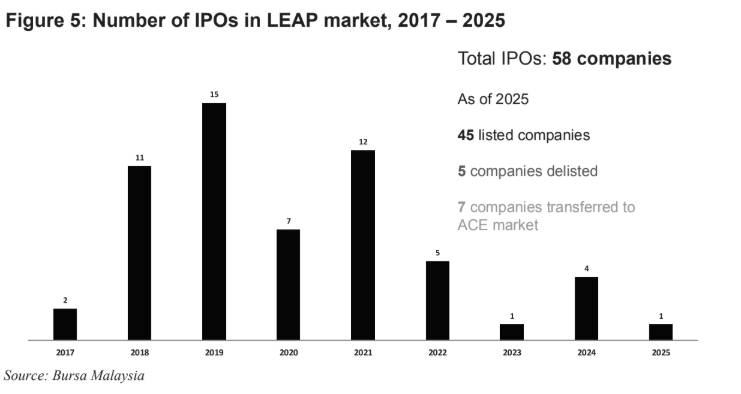
Beyond private capital, Initial Public Offerings (IPOs) serve as a vital exit strategy and a means for growing companies to unlock liquidity. While traditional IPOs on Bursa Malaysia’s Main and ACE Markets are largely reserved for big, late-stage players, the LEAP (Leading Entrepreneur Accelerator Platform) market was launched in 2017. The goal was straightforward: give MSMEs and early-stage startups an easier alternative route to raise public funds while serving as a bridge to the more established ACE market.15
At first, the LEAP market looked like a promising stepping stone for high-growth firms. Since it started, it has hosted 58 listings and raised over RM248 million. Penang-based companies took a modest slice of this pie, raising RM25 million across six listings.16 Yet, despite this encouraging start, the initial momentum has faded. The market has recently seen a steep drop in new listings due to deep-rooted structural issues.
The biggest roadblock is a lack of trading activity. Because regulations restrict LEAP market trading exclusively to sophisticated and high-net-worth individuals, the investor pool is simply too small.17 This has created a highly stagnant environment, so much so that in 2022, several listed MSMEs did not record a single trade for the entire year.18 When you combine this with steep listing fees, the whole value proposition falls apart. A capital market with barely any buyers or sellers ultimately fails to do its job, discouraging ambitious MSMEs from using public listings to fund their next chapter of growth.
5. The government’s current interventions: Bridging the financing gap
To address the structural barriers within the MSME and startup ecosystems, the government is shifting its approach to funding. As outlined in the recent Budget 2026 and the 13th Malaysia Plan (RMKe-13), national policy is moving away from traditional, grant-heavy models. Instead, policymakers are focusing on sustainable financing, capacity building, and opening up alternative capital markets to help businesses scale more effectively.
5.1 Expanding broad-based credit and liquidity support
The most immediate priority is ensuring that essential credit keeps flowing to MSMEs at manageable costs. While Bank Negara Malaysia (BNM) continues to provide dedicated funds through commercial banks to support business recovery, these loans typically still require standard credit assessments.19 To lower this barrier, the government has stepped in to absorb a portion of the risk.
Through Budget 2026, there is a significant expansion of microfinancing and guarantee schemes managed by Syarikat Jaminan Pembiayaan Perniagaan (SJPP), Bank Simpanan Nasional (BSN), and SME Bank.20 By acting as a guarantor, the government allows commercial lenders to safely inject liquidity into smaller firms that would normally be rejected for lacking physical collateral. Alongside this, SME Bank’s newer training programmes focus on practical needs like financial literacy and e-invoicing readiness, helping businesses build the solid track records required to attract future investors.
5.2 Alternative solutions for cash flow bottlenecks: The SARANA Initiative
Beyond traditional banking, policymakers are addressing specific working capital bottlenecks through market-based solutions. A key example is the SARANA initiative, overseen by the Securities Commission Malaysia. Designed specifically for MSMEs and smaller contractors handling government projects, SARANA uses regulated Peer-to-Peer (P2P) platforms such as Funding Societies and MicroLEAP to provide flexible liquidity without demanding heavy collateral.21
SARANA directly targets the persistent cash-flow gaps typical in public sector procurement by offering two practical solutions: invoice financing and contract pre-financing. The first allows MSMEs to convert submitted invoices into near-immediate cash, bypassing the usual wait times for public sector payments. The second provides upfront capital before a project even begins. By smoothing out these operational hurdles, SARANA allows smaller firms to bid for larger government contracts without the fear of draining their internal reserves or disrupting their daily operations.
5.3 Future-proofing: Innovation, Green Finance, and Intangible Assets
For high-growth startups and tech-driven MSMEs, the financing landscape is evolving to better match modern business models. Under RMKe-13, the government is rolling out targeted financing structures backed by insurance and takaful schemes, substituting outdated grant mechanisms. To encourage technology adoption, Budget 2026 introduces strong tax incentives, such as a 50% additional deduction for AI and cybersecurity training. Concurrently, dedicated green financing facilities are being launched with specific incentives to bring in private co-investors.
Perhaps the most significant change is the government’s effort to dismantle the “intangible asset” barrier that has long kept tech startups out of the debt market. New commercialization initiatives such as the pioneering IP collateralization pilot project and the IP Apprentice for Technology Transfer Offices (TTOs) allow tech startups to use their patents and software as legitimate leverage for funding.22 Paired with early-stage semiconductor incubator programmes led by MIDA and MTDC, these steps signal a much more mature, structured effort to fund the nation’s next generation of innovators.
You might also like:
![Lessons from an Adamant Past: Operationalising Malaysia’s Maritime Strategic Culture in the Indo-Pac...]()
Lessons from an Adamant Past: Operationalising Malaysia’s Maritime Strategic Culture in the Indo-Pac...
![Trend of Investments in Batu Kawan Industrial Park]()
Trend of Investments in Batu Kawan Industrial Park
![The Coordination Gap: How Penang’s Elderly Navigate a Fragmented Care System]()
The Coordination Gap: How Penang’s Elderly Navigate a Fragmented Care System
![Helping SMEs Rise to Challenges Posed by the Covid-19 Pandemic]()
Helping SMEs Rise to Challenges Posed by the Covid-19 Pandemic
![Synergy among Stakeholders is Key to the Sustainability of Cultural Tourism in Penang]()
Synergy among Stakeholders is Key to the Sustainability of Cultural Tourism in Penang