

Executive Summary
- Effective discipline management is fundamental to creating a safe, inclusive, and productive learning environment. It supports academic achievement, emotional wellbeing, and character development among students.
- Although the Ministry of Education has introduced comprehensive guidelines on student discipline, inconsistencies remain in implementation. Limited teacher training in positive behavioural management and weak parental involvement continue to hinder policy effectiveness.
- The rise of social media misconduct, cyberbullying, and post-pandemic behavioural changes have added new dimensions to discipline management. Schools require updated frameworks that integrate digital citizenship and mental health support.
- A holistic approach is needed to strengthen teacher capacity, promote restorative practices, enhance data monitoring, and foster collaboration between schools, parents and communities in order to ensure discipline management aligns with Malaysia’s broader education reform goals.
1. Introduction
Growing global attention to student wellbeing has positioned bullying as a critical issue that schools can no longer afford to overlook. Studies examining officially reported bullying cases across six ASEAN countries reveal that physical, psychological, and cyberbullying are widespread, with consistently high incidence rates recorded throughout the region. These findings suggest that existing prevention strategies remain insufficient, highlighting the need for culturally appropriate and comprehensive approaches to create safe and positive school environments (Sayuti et.al., 2020).
Similarly, bullying among school students has become a significant concern in Malaysia, drawing heightened public attention and increased policy scrutiny. The case of 13-year-old Zara Qairina Mahathir, who died in July 2025 after allegedly falling from the third floor of her school hostel following prolonged bullying and school neglect, represents one of the most recent incidents to provoke nationwide concern and debate (Rusreena et al., 2025). While bullying in Malaysian schools is not a new phenomenon, recurring reports of physical aggression, psychological abuse, and peer intimidation suggest that the problem has intensified in recent years, posing serious challenges to the creation of safe, inclusive, and supportive learning environments.
In response to this growing concern, the Ministry of Education Malaysia has implemented several educational discipline policy measures, including the Management Guidebook for Dealing with Bullying in Schools, first introduced in 2005, as well as the establishment of Parent Committees to strengthen school–community collaboration in addressing student disciplinary issues. At the same time, existing disciplinary regulations continue to shape school practices. Under Education (School Discipline) Regulations 1959, guidelines on caning stipulate that only the headmaster or an authorised teacher may administer the punishment, and that it must be carried out in private. More recently, the Dewan Rakyat approved the Anti-Bullying Bill 2025, which aims to prevent and manage bullying incidents across educational and other institutions, and provides for the creation of an Anti-Bullying Tribunal to enhance awareness, reporting, and preventive efforts (Suzalina, 2025). Collectively, these initiatives reflect the Ministry’s commitment to a more integrated, structured, and preventive approach in addressing bullying and promoting student wellbeing.
However, despite the availability of guidelines and regulatory frameworks, many schools continue to face difficulties in managing disciplinary problems comprehensively. Educators, school leaders, and education officers report challenges in translating policy guidance into effective daily practice, particularly in addressing complex behavioural issues shaped by rapid social and technological change.
Contemporary students are growing up in an environment characterised by unprecedented access to information and digital media; this has altered social interactions, behavioural norms, and authority dynamics. These changes have intensified discipline-related challenges within schools, requiring more adaptive, evidence-based, and context-sensitive approaches.
As the primary agent of socialisation beyond the family, schools play a crucial role in fostering students’ holistic development, i.e. emotional, spiritual, physical, and intellectual in line with the National Education Philosophy. Addressing bullying is therefore not merely a disciplinary concern, but a systemic issue that reflects broader social, behavioural, and institutional dynamics requiring coordinated policy intervention.
While existing policies reflect strong commitment, their impact is ultimately determined by consistent implementation at the school level, where students’ behavioural patterns and social values are first institutionalised. Weak enforcement or fragmented practices at this stage risk normalising harmful behaviours.
The persistence of bullying incidents suggests a misalignment between policy design and everyday disciplinary practices. Addressing this gap requires not only regulatory enforcement but also capacity-building, cultural change within schools, and sustained stakeholder engagement.
2. School Bullying in Penang
The Penang Education Department recorded 1,302 bullying and social misconduct cases in schools from 2023 to September 2025, of which 86 bullying cases were reported to the police (Imran & Chern, 2025). Based on statistics from the Penang Education Department, there were 289 cases in 2023, 700 in 2024, and 313 reported up to September 2025. The highest number of police cases was recorded in the Northeast District with 30 incidents, followed by North Seberang Perai (18), South Seberang Perai (20), Southwest District (10) and Central Seberang Perai (eight) (Imran & Chern, 2025).
The Penang State Education Department has taken bullying and social misconduct seriously and has implemented integrated strategies in line with a Ministry of Education circular issued in 2023. These include preventive and value-education programmes, supported by close collaboration with the police, non-governmental organisations (NGOs), the Penang Women’s Development Corporation, the Malaysia Crime Prevention Foundation, and schools across the state (Imran & Chern, 2025).
Large-scale awareness campaigns involving 396 schools have been conducted, alongside town hall engagements and enhanced monitoring of boarding schools. Early intervention measures include counselling services, peer mentoring, social-emotional learning initiatives, community service for offenders, stronger parental involvement, and the use of digital monitoring systems to track student behaviour and identify at-risk students (Imran & Chern, 2025).
Despite these efforts, reported cases indicate that existing measures require further strengthening. Persistent incidents point to the need for more systematic supervision, stronger teacher capacity in behaviour management, improved counselling support, and greater consistency in discipline enforcement across schools.
3. Conceptual Framework: Discipline Management and Bullying
To understand why existing disciplinary policies have struggled to curb bullying in Malaysian schools, it is necessary to clarify the conceptual foundations of discipline management and bullying within the education system. A clear conceptual framework helps distinguish between punitive, control-oriented approaches and developmental forms of discipline that emphasise student growth, responsibility, and well-being. It also situates bullying not merely as individual misconduct, but as a systemic behavioural issue shaped by family environments, school culture, peer dynamics, and institutional capacity. By outlining these core concepts, this section provides the analytical lens through which the causes, impacts, and policy responses to school bullying are examined.
3.1 Definition of Discipline Management
School discipline management is a process of planning, organizing, directing, and controlling that involves the formulation of rules and directives to ensure that students remain in positive condition at all times (Sire, 2021).
In the Malaysian education context, discipline management is governed by the Education Act 1996, the School Discipline Regulations 1959, Ministry of Education professional circulars, and school-based student affairs (HEM) structures. Effective discipline management is not merely punitive, but developmental in nature, supporting students’ moral, emotional, and social growth in line with the National Education Philosophy.
3.2 Definition of Bullying
Bullying refers to deliberate and repeated acts of aggression directed at individuals who are unable to defend themselves, carried out over time by an individual or a group (Ida Rosnita et.al., 2024).
According to the Ministry of Education Malaysia’s guidebook Dealing with Bullying at School, bullying refers to repeated acts of abuse, intimidation, or harassment directed at an individual or group of students, particularly those perceived as vulnerable or weaker. Such acts may be physical, verbal, or psychological in nature and are intended to cause fear, distress, or social exclusion.
4. Causes of Bullying in Schools
The following recommendations outline strategic entry points for strengthening Malaysia’s school discipline ecosystem, focusing on collaboration, capacity-building, student wellbeing, and regulatory alignment to support safe, inclusive, and values-based learning environments.
4.1 Family Environment and Parenting Practices
Children’s behaviour is strongly shaped by their home environment. Inconsistent parenting, limited supervision, exposure to domestic conflict, or overly authoritarian or permissive parenting styles can contribute to aggressive behaviour. In some cases, children replicate behaviours observed at home, including verbal or physical aggression, while others may engage in bullying as a coping mechanism for emotional neglect or insecurity.
4.2 Digital Exposure and Social Media Influence
Unrestricted access to social media platforms and online content has altered students’ behavioural norms. Exposure to violent, sexualised, or humiliating content can normalise aggression and reduce empathy. Cyberbullying further extends harassment beyond school hours, blurring boundaries between online and offline behaviour. The absence of structured digital citizenship education and parental mediation exacerbates this risk.
4.3 Weak School Supervision and Institutional Constraints
Overcrowded classrooms, limited counselling support, and heavy administrative workloads reduce teachers’ capacity to monitor student behaviour effectively. Teachers are often preoccupied with completing the syllabus within limited teaching periods, and tend to focus on students who are academically engaged, leaving less time and attention for supervising and managing the behaviour of less motivated students. Parental resistance to disciplinary actions further discourages teachers from enforcing student discipline. In some schools, inconsistent enforcement of discipline policies and delayed intervention allow bullying behaviours to escalate. These structural constraints undermine schools’ ability to respond promptly and proportionately.
4.4 Teacher Capacity and Discipline Management Approaches
Teachers remain the primary frontline actors in discipline management; however, many lack formal training in behavioural intervention, restorative practices, and socio-emotional learning. Current in-service training tends to prioritise curriculum delivery and assessment, with limited emphasis on classroom behaviour management and student well-being.
Some teachers rely on punitive or control-oriented strategies due to limited continuous professional training in behaviour management. Such approaches may suppress misbehaviour temporarily but often fail to address underlying emotional or social causes. Inconsistent discipline practices across teachers further weaken behavioural norms in the school environment.
4.5 Peer Dynamics and School Climate
Bullying often arises within peer hierarchies where dominance, social status, or group conformity is valued. A school climate that tolerates aggression, normalises teasing, or fails to promote empathy and inclusivity increases the likelihood of bullying. Bystander inaction further reinforces harmful behaviour.
5. Implications of Bullying at School
Bullying is a behaviour that violates school regulations and brings about adverse consequences for the perpetrator, the victim, and the entire school community. Victims of bullying are often characterised by traits such as withdrawal, low self-esteem and shyness. They may experience emotional distress, fear, and social isolation, leading them to conceal their experiences from parents, teachers, and peers due to feelings of shame or fear of retaliation from the bully. Such experiences can result in absenteeism and, subsequently, a decline in academic performance.
In addition to diminished self-worth, victims may develop feelings of resentment and, in some cases, exhibit retaliatory or even more aggressive behaviours towards others as a means of coping or seeking revenge. This creates a cyclical pattern of aggression that perpetuates negative social dynamics within the school environment.
Perpetrators of bullying, on the other hand, are at high risk of engaging in more serious forms of misconduct. Repeated involvement in bullying can lead to behavioural escalation, including criminal activities such as physical assault, which in extreme cases may result in severe injuries or even fatalities. These long-term implications highlight the importance of early intervention and the establishment of a positive school climate that fosters respect, empathy, and emotional wellbeing among students. The data in Table 1 below clearly illustrates a growing pattern of violence and bullying in Malaysian schools.
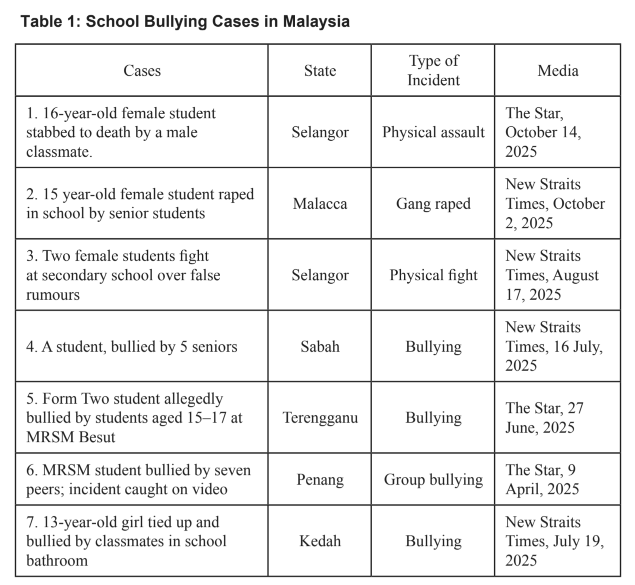
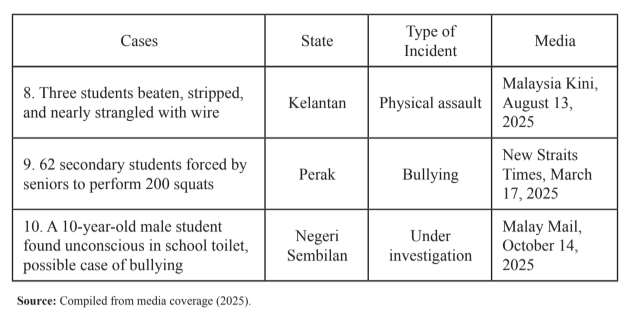
The data in Table 1 illustrate the reported cases, spanning various states involving both primary and secondary school students. The table reveals that such incidents are not confined to a particular region or school type. Instead, they reflect a nationwide concern that cuts across gender, age, and socio-economic backgrounds. The cases range from verbal and physical bullying to serious criminal acts such as assault and sexual violence, highlighting a disturbing escalation in student misbehaviour.
These media-reported incidents urgently indicate that many schools are struggling to maintain effective discipline and to ensure a safe learning environment. Discipline management in many schools continues to rely on punitive and control-oriented measures, which may suppress misconduct temporarily but fail to address its root causes. In schools, informal evidence suggests 52% of students’ experience corporal punishment, especially caning, which remains common in rural areas (Amalina & Muhammad Khairil, 2025). Research increasingly demonstrates that punitive approaches can exacerbate resentment, disengagement, and repeat misbehaviour.
The occurrence of extreme cases such as fatal assaults, group bullying, and peer coercion signals a breakdown in moral guidance and school supervision. This worrying trend underscores the need for urgent policy action to strengthen school discipline management systems, promote students’ emotional intelligence, and enhance teacher training in behavioural intervention. Meanwhile Table 2 shows how youth involvement in crime correlates with the rise in school-based bullying and violence, supporting the call for better discipline management policies in schools.
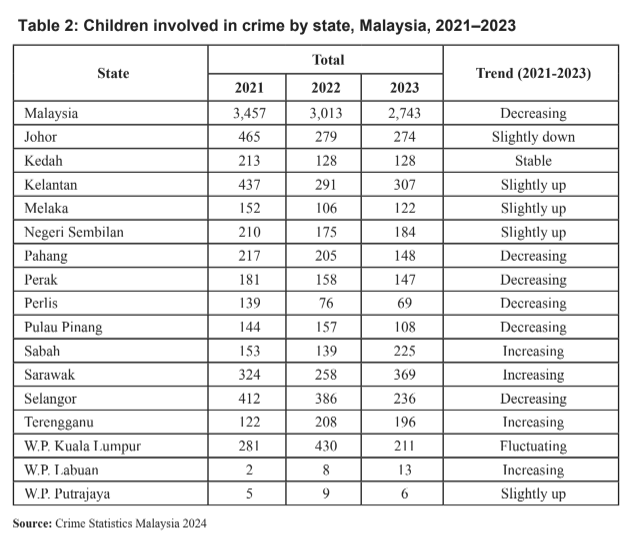
While Table 1 highlights specific school-based bullying and violent incidents, Table 2 presents a broader national picture of children involved in criminal activities from 2021 to 2023. Although the total number of juvenile crime cases in Malaysia has shown a gradual decrease, the pattern across states indicates uneven progress, with states such as Sabah, Sarawak, and Terengganu recording an upward trend. States with juvenile crime trends may reflect gaps in early school-based interventions, highlighting the need for the strengthening of preventive education and discipline management.
The data suggest that despite national efforts to curb juvenile delinquency, underlying behavioural and social issues persist among children and adolescents. When viewed together, the two tables reveal that school violence and student crime are interconnected symptoms of deeper systemic challenges including weak discipline enforcement, insufficient counselling support, and inadequate early intervention programs.
These findings reinforce the urgent need for comprehensive discipline management policies that integrate preventive education, student mental health support, and closer collaboration between schools, parents, and community institutions.
6.0 Classroom and School Discipline Management in Malaysia
A recent Ministry of Education report indicates a sharp increase in school violence cases, rising from 3,883 cases in 2022 to 6,528 in 2023 and 7,681 in 2024 (Sabri, 2025). Although principals and headmasters are guided by Professional Circulars, the Education Ordinances, and the Education Act 1996, the persistence and escalation of disciplinary cases suggest that regulatory frameworks alone are insufficient.
Classroom management has become increasingly complex due to technological integration, diverse learner needs, and evolving student behaviour (Muhammad Latif et al., 2025). Many teachers report difficulty balancing discipline with active learning, partly because teacher preparation programmes do not fully equip them for real classroom challenges. Mohd Mahzan et al. (2022) similarly found inconsistencies in teachers’ behaviour management skills and emphasised the need for structured training and school-wide positive behaviour support systems. Wan Mohd Agil Mat Yamin and Lim Hooi Lian (2025) further highlight that new teachers face pressures related to workload, classroom control, and professional expectations, recommending continuous professional development and micro-training to enhance pedagogical and emotional resilience. Collectively, these studies underscore the importance of systematic institutional support in strengthening teacher capacity.
At the classroom level, research demonstrates that traditional, control-oriented disciplinary approaches are increasingly ineffective. Hou, Jamilah, and Yi Zhao (2024) identified “talking out of turn” as a common disruptive behaviour and found that strategies such as structured participatory sessions and student self-monitoring reduce disruptions while improving engagement. Similarly, Gomathi (2024) and Chear et al. (2024) emphasise teacher leadership, consistent rules, positive reinforcement, and collaborative practices as critical components of effective discipline management. Mohd Faiz (2023) further shows that the Supporter Style characterised by empathy and proactive guidance significantly enhances teacher leadership competency, whereas force-based approaches yield limited positive outcomes.
Beyond the classroom, bullying and disciplinary challenges are shaped by broader socio-ecological influences. Rusreena et al. (2025) and Nik Sarina et al. (2024) identify media exposure, peer conformity, family dynamics, and permissive parenting as significant contributors to student misconduct. These factors weaken self-regulation and social responsibility, complicating teachers’ efforts to maintain order. While some parents continue to endorse corporal punishment, others increasingly support non-punitive approaches (Amalina & Muhammad Khairil, 2025). The findings collectively suggest that effective discipline management requires alignment between classroom strategies, school policies, parental guidance, and wider societal norms.
Overall, classroom discipline in Malaysia cannot rely solely on legal frameworks or punitive measures. Sustainable improvement requires integrated efforts encompassing teacher professional development, participatory pedagogical approaches, strong teacher leadership, and collaborative engagement with families and communities.
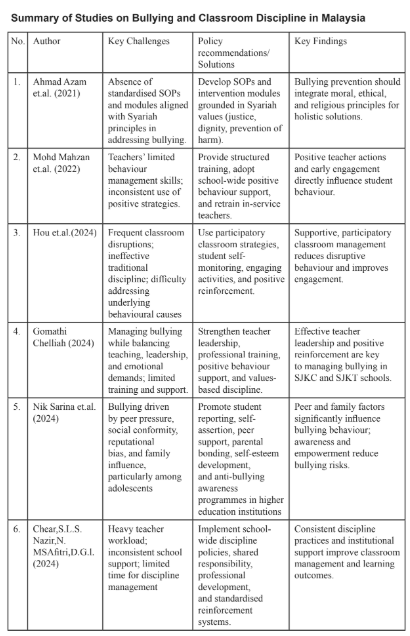
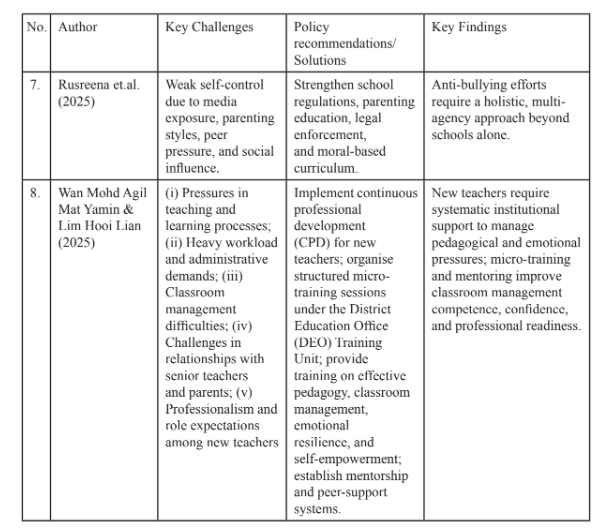
Taken together, the literature suggests that effective classroom and school discipline management in Malaysia depends on supportive pedagogical practices, strong teacher leadership, coherent school policies, and reinforcement from families and wider social structures.
7.0 Policy Recommendation
Effective discipline management is fundamental to education quality and the creation of safe, inclusive learning environments. Given the multidimensional causes of bullying identified in Section 3 ranging from family dynamics and digital exposure to institutional constraints and peer culture, policy responses must be comprehensive, preventive, and systemic rather than reactive or punitive. Discipline management should therefore be repositioned as a core pillar of education governance, aligned with Ministry of Education (MOE) reforms and broader national values on student well-being, dignity, and social responsibility.
The following recommendations propose a future-ready discipline ecosystem that integrates school leadership, parental engagement, community partnerships, digital responsibility, and student well-being.
7.1 Establishing a School-Parent-Community Early Intervention Network
Effective discipline management requires a shift from reactive responses to individual disciplinary incidents towards a coordinated and preventive early intervention model that identifies students at risk before behavioural problems escalate. Schools should establish a structured School–Parent–Community Early Intervention Network involving school personnel, parents, and community stakeholders to strengthen preventive discipline management.
The Network should establish a multidisciplinary Student Early Intervention Team comprising representatives from the Hal Ehwal Murid (HEM) unit, school counsellors, class teachers, PIBG representatives, alumni, community organisations, and relevant agencies. The team should coordinate early identification, behavioural assessment, intervention planning, follow-up monitoring, and referrals to appropriate support services.
The Student Early Intervention Team should be supported by an enhanced school-based Early Warning System that complements existing Ministry initiatives such as the Sistem Pengesanan Murid Berisiko Cicir (SiPKPM), by incorporating behavioural, attendance, academic engagement, and wellbeing indicators relevant to preventive discipline management. The system should enable early identification of students experiencing behavioural concerns, bullying, cyberbullying, social withdrawal, emotional distress, or repeated disciplinary issues, allowing timely interventions before problems escalate.
For cases involving serious violence, weapon-related threats, or potential criminal offences, clear escalation and referral protocols should be established with relevant agencies, including the Royal Malaysia Police (PDRM), health services, and child protection agencies where appropriate, to ensure coordinated risk management and follow-up.
To support nationwide implementation, MOE should develop national operational guidelines for the Student Early Intervention Team, covering membership, referral criteria, intervention procedures, case management, and monitoring responsibilities. This recommendation is informed by international practices in multi-tiered student support and early warning systems, while adapting these approaches to Malaysia’s school discipline management context.
Currently, Malaysian schools operate primarily through reactive disciplinary procedures. This recommendation introduces a preventive, multi-stakeholder early intervention architecture that does not currently exist as a national school discipline management model.
7.2 Professionalising School Discipline Management through Specialised Teacher and HEM Competencies
Malaysia has teacher professional standards, HEM guidelines, and discipline management circulars; however, there is currently no dedicated national competency standard specifically for school discipline management professionals. Discipline teachers are appointed based on school needs, and discipline management training is generally not structured around competency-based assessment or certification. As discipline management is often treated as a collective responsibility of educators, the level of behavioural management expertise may vary across schools.
To promote greater consistency and professionalism, MOE should establish a systematic Professional Competency Framework for School Discipline Management to strengthen teachers’ and HEM personnel’s knowledge and skills in addressing contemporary behavioural challenges.
The framework should define core competencies in areas such as bullying prevention, cyber-related misconduct, restorative practices, conflict resolution, trauma-sensitive approaches, and evidence-based behaviour management. These competencies should be integrated into pre-service teacher education programmes as foundational preparation, while also being strengthened through structured continuous professional development, competency-based assessment, and certification pathways for in-service teachers, discipline teachers, HEM personnel, and school leaders.
The role of HEM units should also be strengthened through clearer professional responsibilities, dedicated resources, and structured monitoring tools. Instead of functioning primarily as an administrative disciplinary unit, HEM should be repositioned as a school-based student support and prevention hub responsible for coordinating early intervention, case management, inter-agency collaboration, and multi-stakeholder responses.
To institutionalise these reforms, MOE should establish a National Professional Competency Standard for School Discipline Management as a common benchmark for teacher preparation, professional development, certification, HEM leadership, and school leadership. The standard should define minimum competency requirements, professional responsibilities, and expected performance outcomes for personnel responsible for discipline management across all schools.
This recommendation represents a shift from discipline management as an informal school responsibility towards a specialised professional competency area supported by national standards and continuous professional development.
7.3 Integrating Digital Citizenship Education into Preventive Discipline Management
Malaysia has implemented digital literacy initiatives, including the Digital Education Policy, DELIMa, and cybersecurity awareness programmes. However, these initiatives are not explicitly positioned as part of a preventive school discipline strategy.
MOE should develop a National Digital Citizenship Framework that provides schools with standardised learning outcomes, implementation guidelines, teacher competencies, and assessment indicators to ensure consistent implementation across primary and secondary education. The framework should position digital citizenship as a core component of preventive discipline management rather than solely as a digital literacy initiative.
The Ministry of Education (MOE) should strengthen the integration of digital citizenship education within the school curriculum to equip students with the knowledge, skills, and values required to navigate the digital environment responsibly. This should include structured learning on ethical online behaviour, empathy, critical thinking, media literacy, digital safety, and responsible social media use.
Given the growing influence of digital technologies on students’ behaviour, digital citizenship education should serve as a preventive discipline strategy by promoting responsible online conduct, reducing cyberbullying, and strengthening students’ understanding of the consequences of inappropriate digital behaviour. It should be embedded across relevant subjects and reinforced through co-curricular activities.
School discipline management systems should also incorporate early behavioural support to identify and address factors contributing to student misconduct. MOE should strengthen school counselling units, establish clear referral and intervention pathways, and provide teachers with training to identify early signs of behavioural changes, social withdrawal, aggression, or emotional distress associated with bullying and digital exposure. Such interventions would enable schools to address underlying causes of misconduct rather than relying solely on punitive responses.
Regional experiences offer useful lessons for Malaysia. In Singapore, cyber wellness is integrated into the Character and Citizenship Education (CCE) curriculum, combining digital responsibility with social-emotional learning. Indonesia has similarly expanded digital literacy initiatives through national education programmes, with increasing emphasis on online safety and responsible digital behaviour. Drawing on these experiences, Malaysia should adopt a more holistic preventive discipline management approach that integrates digital citizenship education with early behavioural support to reduce cyberbullying, strengthen responsible online behaviour, and promote positive student conduct.
This recommendation extends existing digital literacy initiatives by repositioning digital citizenship as a behavioural prevention strategy within the broader school discipline ecosystem.
Conclusion
The persistence of bullying and school violence in Malaysia reflects not a lack of policy commitment, but a misalignment between regulatory frameworks and everyday school realities. While legislation and professional circulars provide an essential foundation, discipline reform must move beyond reactive and punitive measures towards a systemic, preventive, and development-oriented approach.
Strengthening teacher capacity, institutional supervision, restorative practices, digital citizenship education, and structured school–parent–community collaboration is critical to ensuring consistent implementation at the school level. Repositioning discipline management as a core governance priority rather than merely a behavioural issue is central to safeguarding student wellbeing, reinforcing public trust, and advancing Malaysia’s broader human capital and education reform agenda.
REFERENCES
Ahmad Azam, M.S., Mohamad Azhan, Y., Mohd Zamre, M.Z., & Fatimah Yusro, H. (2025). Buli di Malaysia: Permasalahan dan penyelesaiannya dari perspektif Syariah.
Amalina, A., & Muhammad Khairil, R. (2025). Behind the cane: a systematic review of corporal punishment among children in malaysia. MJPCH, Vol. 31 (S1) Special Issue 2025.
Bernama. (2025). Death of Senawang year four student: Investigation papers sent to AGC. Malay Mail. https://www.malaymail.com/news/malaysia/2025/10/14/death-of-senawang-year-four-student-investigation-papers-sent-to-agc/194595
Chear, S. I. S., Nazir, N.M., & Safitri, D. G. I. (2025). Beyond teaching: examining subject teachers’ role in classroom discipline management. Quantum Journal of Social Sciences and Humanities, 6(5): 194-202. https://doi.org/10.55197/qjssh.v6i5.809
Chelliah, G. (2024). Teacher leadership and bullying management: A study of school discipline in SJKC and SJKT schools in Kuala Pilah District. Journal of Public Administration and Governance, Vol. 14(2S).
Crime Statistics Malaysia. (2024). Department of Statistics Malaysia portal. https://open.dosm.gov.my
Hou, M., Jamilah, A., & Yi Zhao. (2024). The effects of classroom disruptive behavioral management strategies for middle school students talking out of turn. International Journal of Academic Research in Progressive Education and Development, Vol. 13.
Ida Rosnita, I., Mohamad Sahizam, M., Samsinar, R., Suria Fadhillah, M.P., & Mohd Azim, Z. (2024). Understanding bullying among primary school children: a preliminary study using a modified social experiment approach. International Journal for Studies on Children, Women, Elderly and Disabled, Vol. 22.
Imran, H., & Chern, L. T. (2025). Penang records 1,300 school bullying, misconduct cases. The Star, 22 November. Link Artikel
Kementerian Pendidikan Malaysia. (2014). Panduan Pengurusan Menangani Buli di Sekolah. https://www.moe.gov.my/
Malaysia Kini. (2025). Form 3 student ‘beaten, stripped, nearly strangled’ by Form 4 bullies. https://www.malaysiakini.com/news/752853
Mohd Mahzan, A., Abdul Talib, M.H., Hua, T.K., & Abdul Razak, A. (2022). Observations of Strategies by secondary school teachers in physical classrooms to promote positive behaviour. Sustainability, 14, 7013. https://doi.org/10.3390/su14127013
Muhammad Zulsyamini, S.S. (2025). 62 secondary school students allegedly forced by seniors to perform 200 squats. New Straits Times. https://www.nst.com.my/news/crime-courts/2025/03/1189545/62-secondary-school-students-allegedly-forced-seniors-perform-200
Muhammad Latif, J., Muhammad Zaman, F., Aqsa, I., & Abeera, L. (2025). Study the classroom management practices at secondary level: Class teacher perception. iRASD Journal of Educational Research, Vol. 6 (1), 60–70. https://doi.org/10.52131/jer.2025.v6i1.2721
National Institute of Health. (2023). National Health and Morbidity Survey 2022: Adolescent health survey. Putrajaya: NIH. https://iku.gov.my/images/nhms-2022/Report_Malaysia_nhms_ahs_2022.pdf
Nik Sarina, N. M. S., Nurhuda, K. A., Atirah, M.R., Syahirah, S., Mohamad Hidayah, A.M., Mohd Amiruddin, I., Wan Nor Azilawanie, T.I., Hasrudy, T., & Mohd Sallehin, J. (2024). Exploring students’ perceptions of bullying: A case study in a Malaysian higher education institution. Jurnal Intelek, Volume 19(1).
Rusreena, R., Nor Fazlin, M.R., Malissa Maria, M., Siti Fauziana, Z., & Farina Nozakiah, T. (2025). Public perceptions of the causes of rising bullying cases and solutions in Malaysian Schools: A qualitative study. International Journal of Research and Innovation in Social Science (IJRISS). https://rsisinternational.org/journals/ijriss/download_pdf.php?id=787
Sabri, S. (2025). Are our school failing? MalaysiaGazette. https://malaysiagazette.com/2025/10/21/are-our-school-failing/
Sayuti, A.G., Burhanuddin, J., Afifah Quraishah, A.N., & Mohd Mahzan, A. (2020). School bullying in Southeast Asia countries: Categories, elements and incidences. International Journal of Psychosocial Rehabilitation, Vol. 24(1).
Sire, E., Al-Amin, M., & Abdul Ghani, K.A. (2021). Hubungan pengurusan disiplin sekolah dan kualiti kehidupan murid di Semenanjung Utara Malaysia. Malaysian Journal of Social Sciences and Humanities (MJSSH), Volume 6(8).
Suzalina, H. (2025). RUU Antibuli 2025 diluluskan selepas dibahas 27 Ahli Parlimen. Berita Harian, 3 Disember. https://www.bharian.com.my/berita/nasional/2025/12/1480247/ruu-antibuli-2025-diluluskan-selepas-dibahas-27-ahli-parlimen
The Star. (2025). MRSM bullying case: Five students from Besut remanded three days. The Star. https://www.thestar.com.my/news/nation/2025/06/27/mrsm-bullying-case-five-students-from-besut-remanded-three-days
The Star. (2025). Seven MRSM students caught bullying to be expelled. The Star. https://www.thestar.com.my/news/nation/2025/04/09/seven-mrsm-students-caught-bullying-to-be-expelled
Wan Mohd Agil, M.Y., & Lian, L.H. (2025). Navigating the struggles: Challenges and pressures faced by new secondary school teachers in Malaysia. Pertanika J. Soc. Sci. & Hum., 33 (6), 2365 – 2389.
Zuliaty, Z. (2025). Jealousy suspected motive in Kedah school bullying case, 2 teenagers detained. New Straits Times. https://www.nst.com.my/news/crime-courts/2025/07/1247295/jealousy-suspected-motive-kedah-school-bullying-case-2-teenagers
You might also like: