


Executive Summary
- State-linked organisations (SLOs) allow governments to organise public functions outside conventional departments while retaining public ownership. They can provide greater flexibility, specialised expertise, alternative financing and additional implementation capacity. The reasons governments use SLOs varies according to their institutional environment. Fiscal resources, administrative capacity, service demands and the distribution of authority across levels of government shape both their purpose and viability.
- Germany shows how corporatisation can become extensively embedded within local government; municipalities already possess broad service responsibilities and use corporate entities across these functions to gain greater managerial, financial and personnel flexibility.
- India illustrates an alternative way of expanding subnational capacity. Rather than relying primarily on corporatisation, states can redistribute functions, personnel and resources to local governments, as demonstrated by Kerala’s decentralisation reforms.
- Penang’s SLOs have added additional capacity within a more constrained administrative and fiscal environment. As these conditions change, the key question is whether existing SLOs can continue to provide distinctive public capacity that justifies their mandates and organisational arrangements.
Introduction
Policy implementation increasingly involves organisations located beyond conventional government departments. The discussion in this ISSUES focuses on state-linked organisations (SLOs)1; these are publicly owned but legally separate entities that operate with varying degrees of organisational and managerial autonomy. Why governments create such organisations varies across institutional settings. Some seek greater efficiency, flexibility or specialised capacity, while others use alternative organisational arrangements to expand implementation capacity within existing constraints. As these conditions change, however, the original rationale for such organisations may also need to be reconsidered.
Focusing on Penang and drawing comparative insights from Germany and India, this article examines why SLOs emerge and how their roles may change as governance evolves.
Why Do Governments Create State-Linked Organisations?
The creation of state-linked organisations (SLOs) is commonly discussed in the public administration literature as public service corporatisation. Corporatisation involves transferring public functions to legally separate corporate entities while retaining them in the “government’s hands”2. These government-owned companies are then able to operate with greater organisational autonomy while remaining under public ownership3.
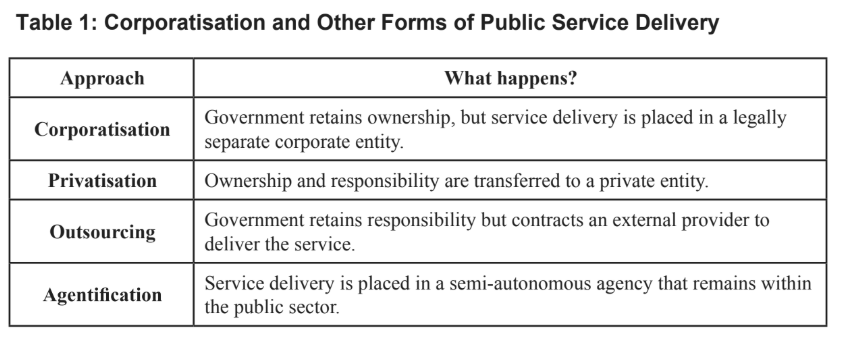
This combination of public ownership and organisational separation distinguishes corporatisation from other forms of public service innovations. Unlike privatisation, ownership is not transferred to private actors, and remains with the government4; unlike outsourcing, service delivery is not contracted to an external provider5. Corporatisation also differs from agentification, where semi-autonomous agencies generally remain within the public sector and operate under public law6. Corporatised entities are legally separate, often established under company law while remaining wholly or substantially government-owned. They therefore occupy an intermediate position between conventional bureaucratic provision and private-sector delivery. Table 1 summarises these distinctions by comparing how ownership, organisational separation and service delivery are structured under each arrangement.
Why governments choose this arrangement varies. Financial pressures can encourage governments to establish corporate entities to diversify revenue sources, access alternative forms of financing, and reduce reliance on direct government funding. However, this relationship is not straightforward. Severe fiscal constraints may also limit governments’ ability to establish and sustain such entities, as they require initial resources and may expose governments to additional financial risks. Corporatisation therefore requires a certain level of fiscal capacity even when it is intended to ease financial pressures.
Besides, service demands and administrative capacity also matter. Larger or more complex service demands may encourage the creation of specialised organisations. Governments with limited internal capacity may use separate entities to acquire expertise or overcome bureaucratic constraints, while governments with stronger capacity may be better equipped to establish and oversee more complex corporate arrangements7. Corporatisation can therefore arise from different administrative conditions and serve different institutional purposes.
Taken together, these factors suggest that corporatisation does not serve a single purpose. Governments may adopt it in response to financial pressures, growing service demands, or limitations in existing administrative capacity. Corporatisation should therefore be understood as one way for governments to reorganise how public functions are performed while retaining public ownership. In some settings, this may primarily provide greater managerial and financial flexibility in delivering public functions; in others, separate organisations may provide additional capacity that is difficult to develop within conventional administrative structures. These different rationales become clearer when corporatisation is examined within particular institutional settings. Germany provides a useful starting point, where extensive local autonomy has enabled municipalities to use corporatised entities as a means of increasing flexibility and efficiency in public service delivery.
Germany: Corporatisation for Flexibility and Efficiency
Germany provides an extensive example of local government corporatisation. One important rationale has been the greater flexibility available outside conventional municipal administration. Corporate entities, particularly those established under private-law forms such as the limited liability company (GmbH)8, face fewer conventional administrative and public-accounting constraints9. This gives managers greater discretion over operational and investment decisions, as well as more personnel flexibility in recruiting specialised expertise on more competitive terms rather than relying entirely on civil-service remuneration structures. Organisational separation can consequently enable faster decision-making, greater responsiveness to changing demand and more commercially oriented management, while services remain under municipal ownership.
Corporatisation has consequently become an important part of German local public-service delivery. In 2019, municipalities owned 16,634 corporate entities, accounting for 87.5 per cent of all public enterprises in the country. These entities operate across sectors including water and waste management, energy, housing, health and social care, and transport10, illustrating the extensive role of publicly owned corporations in municipal service delivery. Scale, capacity and financial flexibility are closely related to this model. Corporate entities can access commercial borrowing and manage investments through their own balance sheets rather than relying exclusively on municipal budget processes; this makes them particularly useful for capital-intensive services11. Their use nevertheless varies considerably with municipal capacity. Municipalities with more than 500,000 residents own an average of 64.1 corporate entities, compared with 30.5 among cities with 250,000–500,000 residents and 22.4 among those with 100,000–250,000 residents. Larger municipalities generally possess greater financial and administrative capacity to establish, finance and oversee separate entities, while smaller municipalities may retain services within the administration or cooperate with neighbouring municipalities. Similar patterns across other countries suggest that corporatisation depends not only on demand for greater flexibility, but also on the capacity to sustain and govern that process12.
The widespread use of corporatisation in Germany also needs to be understood within the country’s highly decentralised system of government. Municipalities enjoy constitutionally protected local self-government and undertake substantial responsibilities for implementing public policy and delivering services across areas such as energy, water, waste management, housing and transport. Municipal laws at the Länder level also provide local governments with the organisational authority to establish or hold shares in corporate entities for public purposes. Corporatisation therefore operates within a system in which municipalities already possess substantial policy, administrative and organisational space; corporate entities provide an additional means of exercising these responsibilities rather than compensating for an absence of local authority.
Greater organisational autonomy nevertheless creates its own governance challenges, particularly in coordinating and overseeing municipally-owned entities. The German experience therefore illustrates both the opportunities and requirements of corporatisation. Its extensive use is enabled by a decentralised institutional environment in which municipalities already possess broad service responsibilities, organisational authority and sufficient fiscal and administrative capacity to establish and sustain separate corporate entities. Corporatisation builds on this existing autonomy by giving municipalities greater managerial, personnel and financial flexibility in performing functions already within their responsibilities. The German case therefore suggests that extensive corporatisation is not a substitute for subnational autonomy; rather, it is partly enabled by it.
India: Subnational Autonomy and Alternative Implementation Channels
India provides a useful contrast because additional subnational capacity need not be organised primarily through corporatisation. State governments possess substantial policy and administrative responsibilities and maintain their own State Civil Services (SCS). They exercise influence over appointments, postings and transfers and possess legislative and administrative discretion across a broad range of state responsibilities. This gives Indian states greater administrative space to organise implementation than is available to subnational governments in more centralised administrative systems, although this autonomy remains bounded by India’s wider federal administrative structure13.
An important constraint is the continued role of the Indian Administrative Service (IAS) and other All India Services within state administrations. Senior state positions are frequently occupied by IAS officers whose recruitment and broader career structures are embedded in an administrative system shared between the Union and state governments. Although state governments exercise considerable authority over officers serving within their administrations, this authority is not absolute; the wider All India Services framework provides institutional protections and retains a role for the Union government in aspects of career and disciplinary administration. State Civil Services give states more direct influence over much of their own administrative machinery, particularly below the most senior levels, but they should not be understood as providing states with unrestricted control over their bureaucracies. Indian states therefore operate with meaningful, but institutionally bounded, administrative autonomy14.
This distinction matters for understanding why governments may—or may not—need separate organisations to expand implementation capacity. Indian states already possess administrative personnel and responsibilities of their own, as well as authority across policy areas that can be devolved to local governments. The constitutional framework for local government identifies developmental functions including agriculture, minor irrigation, health, housing, education and sanitation, while the extent to which functions, finances and personnel are transferred to local institutions depends substantially on decisions taken by individual state governments. States therefore have scope to strengthen implementation not only by creating organisations outside conventional administration, but also by redistributing existing public functions, personnel and resources across levels of government.
Kerala’s decentralisation reforms provide a prominent example. Substantial resources, functions and personnel were transferred to Local Self-Government Institutions (LSGIs)15 through a “big bang” strategy of fiscal devolution. Between 35 and 40 per cent of the state’s development expenditure was devolved directly to LSGIs, while operational responsibility for local institutions and services—including agricultural offices, primary health facilities and schools—was transferred from state departments to local governments. This allowed LSGIs to assume greater responsibility for community-level development while the state retained functions requiring wider coordination16.
Fiscal devolution was accompanied by institutional changes designed to strengthen local implementation capacity. Kerala separated in-principle project approval from technical vetting and merged the District Rural Development Agency into the elected District Panchayat. Where local governments lacked sufficient technical expertise, alternative sources of capacity were developed through the Voluntary Technical Corps, which mobilised retired professionals for technical appraisal and project approval, while civil-society organisations such as the Kerala Sastra Sahitya Parishad were incorporated into planning processes.
The Indian experience therefore broadens the discussion beyond corporatisation. Separate state-linked organisations are not the only means through which subnational governments can acquire or reorganise implementation capacity; the organisational choices available depend partly on the authority, personnel, functions and resources they already control. Kerala could expand local implementation capacity by redistributing these resources through existing public institutions. This provides an important contrast with subnational governments operating with narrower administrative and policy authority, for which separate organisations may assume greater importance as an alternative source of governing capacity.
Penang’s State-Linked Organisations in Comparative Perspective17
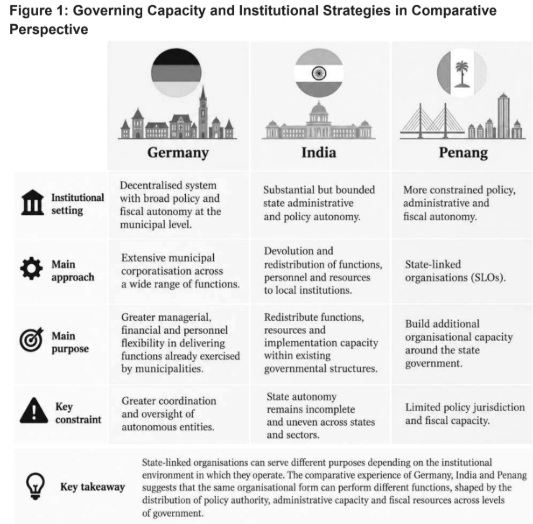
Germany and India illustrate different ways in which subnational governments can expand their governing capacity. German municipalities operate within a decentralised system with substantial service responsibilities, organisational autonomy and the capacity to use corporatisation extensively. Indian states similarly possess significant policy responsibilities, their own administrative machinery, and meaningful discretion to redistribute functions, personnel and resources across state and local institutions. Despite important differences between them, both therefore operate with substantial institutional space within which governing capacity can be reorganised.
Penang operates within a narrower policy, administrative and fiscal space. Malaysian state governments exercise responsibility over fewer policy domains and have limited fiscal autonomy. Penang also has fewer administrative instruments than Indian states, which maintain their own State Civil Services and exercise greater control over middle and lower administrative tiers. Local governments in Penang possess their own administrative machinery, but are unelected and operate within federal and state-local arrangements that constrain the functions available to them. The wider Malaysian system also allows certain local functions to be centralised through federal legislation, as illustrated by solid-waste management under Act 672 in participating states18. Penang therefore has less scope either to develop extensive municipal corporatisation on the German scale or to redistribute substantial functions, personnel and resources downward as Indian states can do.
Within these constraints, state-linked organisations have provided Penang with a different means of expanding governing capacity. The comparison suggests that similar organisational arrangements can perform quite different institutional functions. In Germany, corporatisation is extensively used across functions already exercised by municipalities, providing greater flexibility in how existing responsibilities are delivered. In India, decentralisation allows state governments to redistribute functions, personnel and resources already within their institutional control. In Penang, some SLOs have instead provided additional organisational capacity where the state government’s control over conventional administrative channels is more limited. They have enabled the state to recruit expertise beyond conventional administrative structures, expand its talent pool, develop specialised implementation capacity and pursue selected policy priorities through organisations more directly linked to the state government. Initiatives such as Gender Responsive and Participatory Budgeting (GRPB), for example, illustrate how alternative organisational arrangements can also support participatory approaches that are not necessarily embedded within conventional administrative structures.
The comparison also reveals the limits of this strategy. SLOs can expand organisational capacity and reduce dependence on conventional administrative channels, but they cannot remove the underlying policy and fiscal constraints facing the state government. Unlike German municipalities, Penang operates with narrower policy and fiscal autonomy and therefore has fewer functions and resources around which extensive corporatisation can be developed. SLOs can expand organisational capacity within these constraints, but they cannot remove the underlying limits on state jurisdiction or fiscal resources. Unlike Indian states, it has less scope to transfer state-controlled functions, personnel and resources across different levels of government. Moreover, where SLOs depend substantially on state funding, Penang’s limited fiscal autonomy constrains its ability to sustain an expanding network of organisations. The same institutional constraints that increase the value of alternative organisational capacity may therefore also limit its scope and long-term sustainability.
This tension becomes particularly important as Penang’s political and institutional environment changes. Changes in federal-state relations may alter the extent to which alternative implementation channels are required to navigate administrative constraints, while functions accumulated by SLOs over time may no longer correspond neatly to the circumstances in which they were established. Recurring questions raised by members of the Penang State Legislative Assembly over the functions, expenditure and continued relevance of particular SLOs also point to broader concerns over their evolving roles and public purpose19. These developments suggest that the role of Penang’s SLOs should be routinely reassessed as the conditions that shaped their development evolve.
The question facing Penang is therefore what forms of additional institutional capacity the state continues to require and which organisations are best placed to provide for that function. Some SLOs may continue to provide capabilities that cannot readily be reproduced within conventional departments or local governments; others may require mandate revision, consolidation, new financing arrangements or reintegration into existing public institutions. Germany and India offer not models for Penang to replicate, but comparative reference points for understanding how different distributions of policy authority, administrative capacity and fiscal resources shape the organisational choices available to subnational governments.
Figure 1 summarises how these different institutional settings shape the organisational strategies available to subnational governments:
Conclusion: Rethinking the Role of Penang’s SLOs
State-linked organisations can serve different purposes depending on the institutional environment in which they operate. The experiences of Germany, India and Penang show that organisational arrangements cannot be understood solely in terms of efficiency or managerial flexibility. They also reflect the distribution of policy authority, administrative capacity and fiscal resources across levels of government. German municipalities use corporatisation within a system that already provides substantial local responsibilities and autonomy, while Indian states possess sufficient policy and administrative space to redistribute functions, personnel and resources across subnational institutions. Penang’s SLOs, by contrast, have also served as a means of building additional organisational capacity within a more constrained state-level environment.
This comparison suggests that the value of an SLO lies not simply in its organisational form, but in the distinctive public capacity it provides. Organisational separation may be justified where it enables the state to access specialised expertise, implement functions more effectively, experiment with new approaches or provide capabilities that cannot readily be reproduced through conventional administrative structures. At the same time, creating separate organisations generates its own costs: financing requirements, coordination problems, potential functional overlap and the need for effective public oversight. The continued existence of an organisation should therefore not in itself be treated as evidence that its original institutional rationale remains valid.
This is particularly relevant for Penang as the political, administrative and fiscal environment in which its SLOs operate continues to evolve. Organisations created or expanded under earlier conditions may remain important, but their mandates and institutional arrangements need not remain unchanged. Repositioning should therefore begin with public purpose rather than organisational preservation: what capacity does the state require, whether an existing SLO remains the appropriate vehicle for providing it, and what organisational and financing arrangement can sustain that role. Depending on the answer, this may involve strengthening an organisation, revising its mandate, consolidating overlapping functions, developing alternative financing arrangements, reintegrating functions into existing public institutions or, where a distinctive public purpose can no longer be demonstrated, reconsidering the need for a separate entity.
A systematic mapping of Penang’s SLOs provides the necessary starting point. Examining their origins, mandates, relationships with government, financial arrangements, governance structures and areas of functional overlap would make it possible to assess not simply whether these organisations should survive, but what institutional capacity Penang needs them to provide. Such an exercise can ultimately support a more deliberate state-linked organisational landscape—one shaped by Penang’s present and future governance needs rather than solely by the institutional circumstances under which individual organisations were originally created.
Footnotes
- The term state-linked organisation (SLO) is preferred in this article rather than the more commonly used government-linked company (GLC). GLC generally refers to companies in which government has an ownership or controlling interest and can imply a more commercially oriented corporate form. SLO is used here as a broader term to capture the range of legally separate organisations linked to the Penang state government, including entities whose primary purpose may be developmental, policy-oriented or service-related rather than commercial. The term therefore places emphasis on the organisation’s institutional relationship with the state rather than its corporate form or commercial orientation. ↩
- Peter McKinlay, “The Role of Local Authority-Owned Companies: Lessons from the New Zealand Experience,” in Graham Sansom and Peter McKinlay (eds.), New Century Local Government: Commonwealth Perspectives (London: Commonwealth Secretariat, 2013), pp. 189–211. ↩
- The spread of such arrangements has often been associated with New Public Management reforms that gained prominence since the 1980s. See Gernod Gruening, “Origin and Theoretical Basis of New Public Management,” International Public Management Journal, Vol. 4, No. 1 (2001), pp. 1–25. International Public Management Journal, 4(1):1-25. ↩
- Privatisation involves the transfer of a public task to a private organisation, with responsibility for its delivery transferred to the private entity. See Gianluca Veronesi, Ian Kirkpatrick, Ali Altanlar and Francesco Sarto, “Corporatization, Administrative Intensity, and the Performance of Public Sector Organizations,” Journal of Public Administration Research and Theory (2022), https://doi.org/10.1093/jopart/muac048. ↩
- Benjamin Friedländer, Manfred Röber and Christina Schaefer, “Institutional Differentiation of Public Service Provision in Germany: Corporatisation, Privatisation and Re-Municipalisation,” in Sabine Kuhlmann, Isabella Proeller, Dieter Schimanke and Jan Ziekow (eds.), Public Administration in Germany: Governance Structures and Public Sector Reform (Cham: Palgrave Macmillan, 2021), pp. 291–331. ↩
- Agentification generally refers to the creation of semi-autonomous public organisations with greater managerial autonomy from ministerial departments while remaining within the public sector. See Koen Verhoest, Sandra Van Thiel, Geert Bouckaert and Per Lægreid (eds.), Government Agencies: Practices and Lessons from 30 Countries (Basingstoke: Palgrave Macmillan, 2012). ↩
- Rhys Andrews, Laurence Ferry, Chris Skelcher and Piotr Wegorowski, “Corporatization in the Public Sector: Explaining the Growth of Local Government Companies,” Public Administration Review, Vol. 80, No. 3 (2020), pp. 482–493. ↩
- GmbH (Gesellschaft mit beschränkter Haftung) is the German legal form for a limited liability company. It is a separate legal entity in which the liability of shareholders is generally limited to their investment in the company. German municipalities commonly use the GmbH form for municipally-owned companies delivering public services. ↩
- George Grossi and Christoph Reichard, “Municipal Corporatization in Germany and Italy,” Public Management Review, Vol. 10, No. 5 (2008), pp. 597–617, https://doi.org/10.1080/14719030802264275 ↩
- In 2019, water supply, waste disposal and pollution abatement accounted for 3,669 municipal corporate entities in Germany, followed by energy supply (2,469), housing (2,166), health and social care (1,265), and transport and storage (728). See Marieke Van Genugten, Bart Voorn, Rhys Andrews, Ulf Papenfuß and Harald Torsteinsen (eds.), Corporatisation in Local Government: Context, Evidence and Perspectives from 19 Countries (Cham: Palgrave Macmillan, 2023), https://doi.org/10.1007/978-3-031-09982-3. ↩
- Germany’s energy sector provides a prominent example. Municipal energy companies generated approximately €208 billion in revenue, while local governments reclaimed more than 160 energy concessions between 2007 and 2012 and established 72 new municipal energy utilities between 2005 and 2015. See Van Genugten et al., Corporatisation in Local Government (2023). ↩
- Similar relationships between municipal scale and the use of corporatised entities have been observed in Poland, Italy, Canada, Switzerland and Slovakia. See Van Genugten et al., Corporatisation in Local Government (2023). ↩
- K. P. Krishnan and T. V. Somanathan, “The Civil Service,” in Devesh Kapur, Pratap Bhanu Mehta and Milan Vaishnav (eds.), Rethinking Public Institutions in India (New Delhi: Oxford University Press, 2017), pp. 339–416, https://doi.org/10.1093/oso/9780199474370.001.0001. ↩
- Akshay Mangla, Making Bureaucracy Work: Norms, Education and Public Service Delivery in Rural India (Cambridge: Cambridge University Press, 2022). ↩
- Local Self-Government Institutions (LSGIs) in Kerala refer to elected local government bodies comprising Grama Panchayats, Block Panchayats and District Panchayats in rural areas, and municipalities and municipal corporations in urban areas. They are distinct from the state-linked organisations discussed in this article: LSGIs constitute a tier of elected local government rather than legally separate organisations owned or controlled by the state government. Following India’s 73rd and 74th constitutional amendments, Kerala transferred substantial functions, resources and administrative responsibilities to these institutions. Their relevance to the present discussion lies precisely in this distinction; where subnational governments possess sufficient authority over functions, personnel and resources, implementation capacity can be redistributed to existing levels of government rather than necessarily being located in separate state-linked organisations. ↩
- T. M. Thomas Isaac and Richard W. Franke, Local Democracy and Development: People’s Campaign for Decentralized Planning in Kerala (New Delhi: LeftWord Books, 2000); M. S. John and Jos Chathukulam, “Measuring Decentralisation: The Case of Kerala (India),” Public Administration and Development, Vol. 23 (2003), pp. 347–360, https://doi.org/10.1002/pad.277. ↩
- For a more detailed discussion of Penang’s state-linked organisations and their role in expanding state capacity within Malaysia’s federal system, see Chan (2026), “Governing Within Constraints: How Penang Builds State Capacity in a Centralised Federation,” Penang Institute Issues. ↩
- Act 672 refers to the Solid Waste and Public Cleansing Management Act 2007, which provides for federal regulation and management of solid waste and public cleansing in states that have adopted the federal solid-waste management regime. Penang has not adopted Act 672 and continues to manage solid waste through its local authorities. ↩
- Such concerns have been raised at different points in Penang. In 2021, PKR assemblyman Lee Khai Loon questioned the need for additional GLCs and called for existing entities to be rationalised where their functions overlapped. More recently, Chief Minister Chow Kon Yeow acknowledged the need to restructure Penang’s GLC ecosystem, including by consolidating entities with overlapping functions and encouraging them to diversify their revenue sources to reduce reliance on state funding. See “Why Do You Need More GLCs, Penang Backbencher Questions Govt,” Free Malaysia Today, 3 December 2021, https://www.freemalaysiatoday.com/category/nation/2021/12/03/why-do-you-need-more-glcs-penang-backbencher-questions-govt; Chow Kon Yeow, “Ucapan Penggulungan Mesyuarat Pertama Penggal Ketiga Dewan Undangan Negeri Pulau Pinang Kelima Belas,” Pejabat Ketua Menteri Pulau Pinang, 22 May 2025, unpublished manuscript. ↩
You might also like: