

Realising Malaysia’s EV Future: Innovation after Policymaking
By David Chai (Quantitative Data Researcher)
Executive Summary
- Malaysia sits in the middle tier of ASEAN electric vehicle (EV) adoption. Although EV adoption is steadily growing, EV sales at present account for a significantly smaller fraction of total car sales than in Thailand and Vietnam.
- Malaysia’s EV growth has been supported by tax incentives and national roadmaps. It has reached 6% of market share, while more than 4,000 urban-focused charging bays have been installed. (New Straits Times, 2025).
- In ASEAN as a while, EV adoption saw a significant rise in 2025 (60% sales increase). EV ownership remains low at 11%, and charging infrastructure distribution is also uneven (PwC, 2025).
- Charging infrastructure is critical to EV adoption. A reliable network reduces range anxiety and makes EVs practical for both urban and long-distance travel. Investments are increasing in fast chargers, urban hubs, and residential solutions, with efforts to standardize technology and integrate renewable energy for accessibility and sustainability.
Introduction
The global transition to EVs and their charging infrastructure is accelerating, driven by government policies, technological advancements, economic incentives, and environmental concerns. Governments worldwide are implementing stricter emissions standards, phasing out internal combustion engines, offering subsidies and tax credits. In major markets such as China, Europe, and the United States, these measures have prompted automakers, alongside energy providers to expand EV production and scale up charging networks.
Meanwhile, EV sales in ASEAN-6 countries rose by over 60% in 2025, accounting for approximately 17% of total vehicle sales, though only about 11% of consumers currently own EVs (PwC, 2025). Infrastructure growth is uneven, with Thailand in regional deployment and countries like Malaysia, Indonesia, and the Philippines scaling networks through national targets and policy support.
In Malaysia, while national incentives and roadmaps are increasing adoption, EVs’ market share was only 6% in 2025, and while more than 4,000 charging bays are concentrated in urban areas, rural areas remain under-served (New Straits Times, 2025).
Building a Sustainable EV Ecosystem: Policies, Partnerships, and Charging Networks
The Malaysian government has taken a holistic approach to accelerate EV adoption and the rollout of charging infrastructure, integrating EVs within its broader sustainability and economic transformation strategies. Central to this effort are comprehensive policy frameworks such as the National Automotive Policy (NAP), the National Energy Policy (NEP), the Low Carbon Mobility Blueprint (LCMB), and the National Energy Transition Roadmap (NETR). These frameworks collectively set targets to electrify transport, reduce greenhouse gas emissions, and position Malaysia as a regional hub for sustainable mobility and green technology. Under NETR, EVs are targeted to account for a substantial share of new vehicle sales by 2030 and form a cornerstone of the nation’s shift toward a low-carbon transport ecosystem, reflecting long-term climate commitments.
Complementing these structural policy drivers, recent global oil price increases linked to the ongoing Middle East conflict have further reinforced the economic case for EV adoption. Higher crude oil prices are expected to accelerate EV penetration, as households and businesses seek alternatives to volatile fuel costs. Fuel price surges drive greater interest in EVs due to their comparatively stable operating costs. While Malaysia’s EV transition is fundamentally policy-driven, external energy price shocks strengthen the attractiveness of electrified transport.
To incentivise both consumers and industry stakeholders, the government has introduced a range of tax and fiscal incentives as well. These include full exemptions on excise duties for locally assembled EVs until 31 December 2027, as well as road tax exemptions for EV owners. Individuals installing or subscribing to home charging facilities can claim personal income tax relief of up to RM2,500 annually, reducing upfront costs and encouraging residential charging uptake (MGTC, 2024). To support industry growth, companies manufacturing EVs or components including charging equipment are eligible for tax exemptions and allowances such as the Green Investment Tax Allowance (GITA). This provides a 100% investment tax allowance over five years, and full income tax exemption for EV-charger manufacturers from 2023 to 2032.
Recognising that charging infrastructure is a critical enabler of EV adoption, the government set a target of installing 10,000 charging bays by 2025 through coordinated planning, streamlined regulatory processes, and public-private partnerships (MIDA, 2025). The Malaysia Electric Vehicle Charging Network (MEVnet) platform, developed by the Ministry of Housing and Local Government (KPKT) and MGTC, centralises planning and supports nationwide rollout, ensuring accessibility and interoperability of chargers. In addition, the establishment of the National EV Steering Committee (NEVSC) and the National EV Task Force (NEVTF) under the Ministry of Trade, Investment and Industry (MITI) provides institutional leadership to drive policy coherence, remove bottlenecks, and attract investment in both EV adoption and infrastructure installation.
Private sector collaboration has also been a central part of this strategy. Major energy and infrastructure companies such as Tenaga Nasional Bhd (TNB) and Gentari are investing millions of ringgit to expand charging networks nationwide. Smaller Charge Point Operators (CPOs) like ChargEV and JomCharge are also contributing to broader network growth, often leveraging federal incentives to expand into new areas. These partnerships, coupled with government tax breaks and streamlined guidelines for charging bay installations, are intended to reduce “range anxiety,” lower barriers to EV ownership, and create a sustainable EV ecosystem in Malaysia.
The Struggle to Expand EV-charging Networks
Despite policy ambitions and infrastructure goals, Malaysia continues to encounter challenges in expanding its EV charging network and accelerating EV adoption.
A core constraint is the gap between infrastructure targets and actual rollout progress. The government had set a target of 10,000 charging bays nationwide by the end of 2025 to support EV uptake and ecosystem development (Bernama, 2025). However, as of late 2025 there were only around 4,100 public charging bays on the ground, representing roughly 40% of the goal (Bernama, 2025). This shortfall highlights the difficulty of translating policy ambition into tangible deployment.
A primary bottleneck lies in high installation costs and grid limitations. MITI has admitted that significant capital requirements especially for DC fast-charging units are slowing infrastructure expansion, with single DC chargers costing tens of thousands of ringgit to install. Limited grid capacity further complicates deployment, as many locations, especially malls, condominiums, and high-rise residential buildings lack adequate electrical load capacity to support multiple high-power chargers.
Regulatory hurdles compound these technical and cost barriers. Approval processes for charging bays had required multiple agency clearances; but despite the progress made to streamline approvals, delays persist, and industry stakeholders continue to cite regulatory complexity as a constraint. Plans are afoot to unify charger data and user services under a single e-Mobility Service Platform (EMSP) aiming to improve accessibility and coordination.
Furthermore, the majority of existing chargers are concentrated in urban centres such as Kuala Lumpur, Selangor, and Johor. This creates an infrastructure gap in the country, and contributes to “range anxiety” among potential EV adopters.
Consumer behaviour and market barriers also play a role. Many Malaysians remain cautious about EV ownership due to concerns over charging accessibility, high upfront costs, and perceived inconvenience factors that can dissuade mainstream buyers and limit scaling beyond early adopters.
In addition, according to Tan Jian Ding et al. (2025) there is no overarching legal framework addressing the disposal, reuse, and recycling of EV batteries. Existing environmental regulations tend to focus on industrial electronic waste, which means the disposal of lithium-ion batteries from privately owned EVs are not adequately accounted for. The lack of clear obligations requiring manufacturers to manage battery take-back schemes or end-of-life recycling raises concerns about long-term environmental protection.
Another challenge is reliance on private sector investment. While certain countries directly fund charging infrastructure, Malaysia relies heavily on private operators. While financial incentives such as tax allowances and reduced tariffs exist, limited direct government funding results in uneven development. Private operators are naturally inclined to prioritize locations with higher vehicle traffic and faster returns on investment, leaving smaller towns and rural regions with minimal infrastructure.
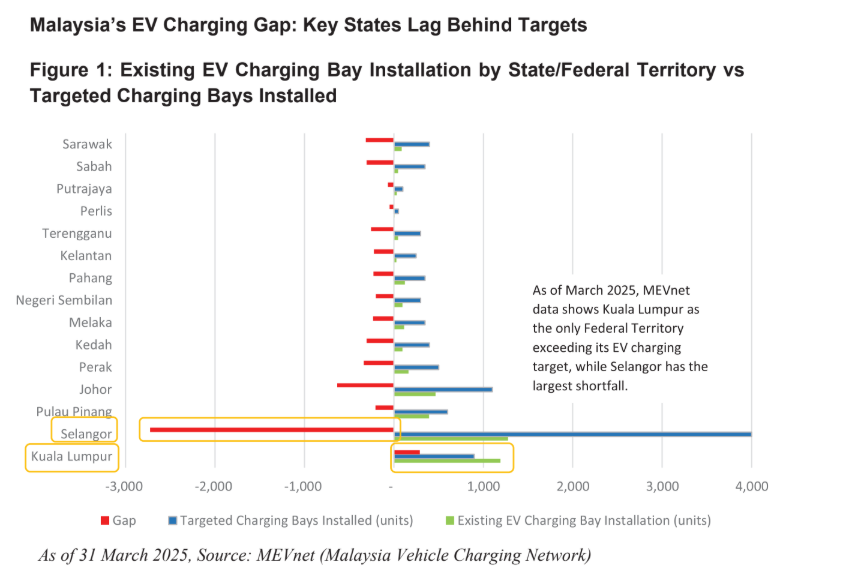
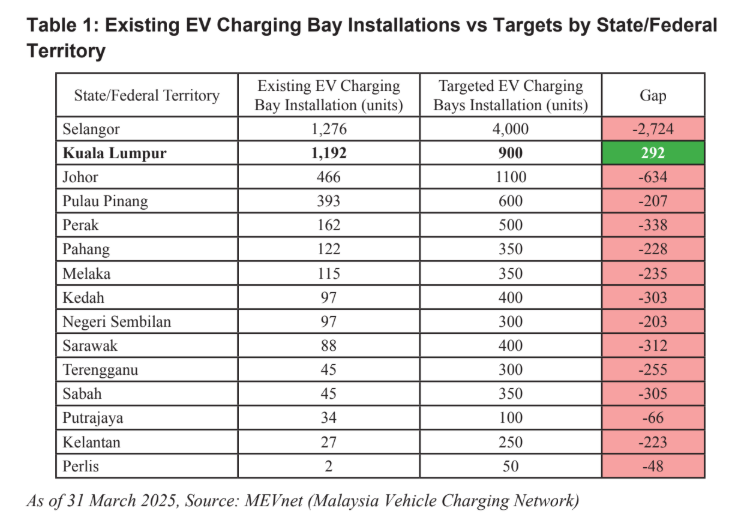
Figure 1 and Table 1 show the EV charging infrastructure in Malaysia remaining highly concentrated in key urban and economic hubs, with Selangor and Kuala Lumpur leading with 1,276 and 1,192 charging bays installed, respectively. Furthermore, all states and Federal Territories fall behind their charging bay installation targets except Kuala Lumpur, for whom the target was 900.
Selangor has the largest shortfall (-2,724) between existing charging bays installed and its target of 4,000. In addition, wide shortfalls in states such as Johor (-634), Sabah (-305), and Sarawak (-312) highlight uneven infrastructure readiness in Malaysia, suggesting that EV adoption may remain geographically skewed.
In Penang, 393 charging bays have been installed against a target of 600. This puts Penang ahead of many states in charging bay installations, including Perak at 162 and Kedah at 97. However, Penang still lags behind Johor, Kuala Lumpur and Selangor.
Penang’s progress remains constrained by several key challenges. Charging bays are concentrated in urban areas like George Town and Bayan Lepas. Penang also lacks sufficient fast chargers, which limits long-distance travel and rapid charging convenience. Additionally, grid capacity constraints, high installation costs, and regulatory delays slow the rollout of new infrastructure. These limitations, combined with consumer concerns about accessibility and convenience, mean that while the state shows growth potential, broader EV adoption may be hindered until coverage expands and high-speed charging options improve.
Given Penang’s role as a key economic and manufacturing hub, accelerating charging bay installations especially in residential areas and along intercity routes will be critical to prevent it falling behind as EV adoption scales nationally.
EV Adoption in the Region: Policy, Infrastructure, and Success Stories
Neighbouring countries such as Indonesia, Thailand, and Singapore have demonstrated successes in advancing EV adoption and charging infrastructure, reflecting tailored strategies suited to their markets.
In Indonesia, the government effectively leveraged industrial policy and incentives to stimulate both demand and production. Tax breaks, import duty waivers, and investments in battery supply chains have encouraged EV adoption, and positioned the country as a future EV manufacturing hub. State-owned electricity provider PT PLN expanded public charging infrastructure rapidly, establishing thousands of AC and DC chargers as well as battery swap stations. This proactive approach ensures that growing EV adoption is supported by accessible charging bays in urban centres.
Thailand has successfully integrated policy and infrastructure development through the 30@30 initiative, targeting 30% of vehicles produced by 2030 to be zero-emission. Coordinated subsidies, tax incentives, and engagement with state and private operators have enabled the installation of over 11,400 chargers, including fast-charging and battery swap stations (Wong, 2025). Thailand’s systematic planning ensures urban users have reliable access to charging while ongoing efforts extend coverage to regional areas, balancing growth with accessibility.
Meanwhile, Singapore exemplifies comprehensive planning and infrastructure density. Under the Singapore Green Plan 2030, the government aims for 60,000 chargers by 2030, integrating installations into Housing & Development Board estates and private residences. Over 13,800 chargers are already operational, supported by grants such as the EV Common Charger Grant, ensuring accessibility for high-density housing residents. Singapore’s approach combines strong policy, coordinated public-private collaboration, and urban planning to achieve high charger coverage per EV, making it a regional leader (Land Transport Authority Singapore, 2025; Ministry of Transport Singapore, 2025).
Collectively, these countries demonstrate that success in EV adoption relies on aligning policy incentives, infrastructure deployment, and private sector collaboration. Indonesia excels in rapid market growth and industrial integration, Thailand balances policy and infrastructure deployment, and Singapore achieves high-density, equitable coverage through advanced planning.
Optimising EV Charging Network Through IoT and Smart Grid Integration
The installation of EV charging bays in Malaysia faces technical, operational, and geographic constraints that have slowed nationwide EV adoption. A practical and scalable solution to these challenges is the integration of Internet of Things (IoT) technologies into charging networks. IoT refers to interconnected systems that collect, transmit, and analyse real-time data, enabling smarter decision-making, improved operational efficiency, and more effective infrastructure planning. In Malaysia, this aligns with broader government initiatives promoting smart grids, digital energy management, and interoperable charging platforms under national frameworks such as the National Energy Transition Roadmap (NETR) and the Malaysia Electric Vehicle Charging Network (MEVnet).
Malaysia’s EMSP has been formally approved but is still in the implementation phase rather than full real-world deployment. The government, through agencies such as Malaysia Automotive, Robotics and IoT Institute (MARii) and industry partners, is actively developing the platform as part of the national EV infrastructure strategy. Its goal is to create a single, unified digital ecosystem where EV users can locate chargers, start charging sessions, and make payments seamlessly across all operators. While the design includes interoperability standards, smart contracts, and blockchain-based data security, these features are still being built and tested. Current efforts focus on system integration, stakeholder coordination, and technical development, indicating that EMSP is progressing but not yet publicly operational at a nationwide level (National Energy Council, 2025).
In practice, many of EMSP’s intended functions already exist in fragmented, real-world forms. Several charging providers in Malaysia have introduced partial interoperability through roaming agreements, while certain EV brands offer mobile apps that aggregate access to multiple charging networks. These existing solutions demonstrate that the core concept of EMSP is technically viable but although already in use, is not yet unified under a single national system.
Singapore Case Study and Practical Implications for Penang
Singapore provides practical case study for the development of an integrated EV-charging ecosystem, particularly due to its strong regulatory framework and coordinated implementation strategy.
From an operational perspective, Singapore achieves interoperability not through a single unified platform, but through the adoption of open standards and coordinated partnerships among charging providers. Technologies such as Open Charge Point Protocol (OCPP) and Open Charge Point Interface (OCPI) enable seamless communication between different charging networks, allowing users to access multiple providers using compatible applications or roaming services. Real-world implementations such as cross-border charging partnerships between Singapore-based operators like SP Group and Malaysian providers, demonstrate that multi-operator integration is already functioning effectively in practice. Furthermore, government-supported initiatives such as the EV Common Charger Grant (ECCG) incentivise private sector participation, and accelerate infrastructure deployment across residential and commercial sectors.
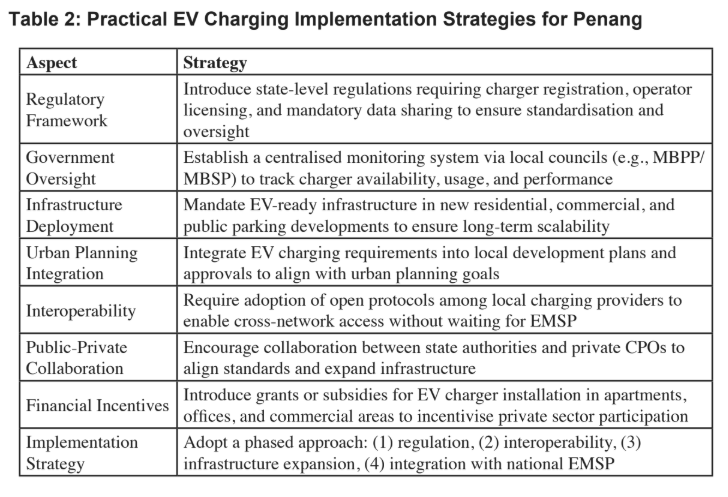
For Penang, the Singapore model highlights several practical and actionable strategies as shown in Table 2.
Conclusion
In conclusion, integrating IoT technologies into Malaysia’s EV charging ecosystem represents a pivotal step toward overcoming the nation’s adoption barriers and infrastructure gaps. With EV uptake concentrated in urban centres and rural regions largely under-served, IoT-enabled grid management, predictive maintenance, and data-driven site optimisation can ensure smarter, more strategic deployment of chargers nationwide. Coupled with national initiatives such as MEVnet and the NETR, IoT integration supports interoperability, seamless user experience, and real-time network monitoring, helping align Malaysia’s charging infrastructure with projected EV growth. Ultimately, embracing IoT solutions positions Malaysia to accelerate EV adoption, bridge urban-rural infrastructure disparities, and advance toward its low-carbon mobility and sustainability goals.
References
- Bernama. (2025) “Malaysia aims for 10,000 EV charging stations by 2025”. Available at: https://www.bernama.com/en/news.php/bfokus/general/news.php?id=2425940 (Accessed: 15 April 2026).
- Bernama. (2025) “Malaysia has over 4,100 EV charging points nationwide — Fadillah”. Available at: https://www.bernama.com/en/news.php/?id=2465239 (Accessed: 15 April 2026).
- Land Transport Authority Singapore. (2025) “Electric vehicles — charger deployment and roadmap”. Available at: https://www.lta.gov.sg/content/ltagov/en/industry_innovations/technologies/electric_vehicles.html (Accessed: 15 April 2026).
- Malaysia Green Technology and Climate Change Corporation. (2024) “Malaysia announces tax incentives for electric vehicles”, 29 November. Available at: https://www.mgtc.gov.my/2024/11/malaysia-announces-tax-incentives-for-electric-vehicles/ (Accessed: 15 April 2026).
- Malaysia Investment Development Authority. (2025) “Powering the future: accelerating Malaysia’s EV charging revolution for sustainable mobility”. Available at: https://www.mida.gov.my/powering-the-future-accelerating-malaysias-ev-charging-revolution-for-sustainable-mobility/ (Accessed: 15 April 2026).
- Ministry of Transport Singapore. (2025) “Electric vehicles and Singapore Green Plan 2030”. Available at: https://www.mot.gov.sg/what-we-do/green-transport/electric-vehicles/ (Accessed: 15 April 2026).
- National Energy Council. (2025) “Government approves National e-Mobility Service Platform to unify EV charging operations across Malaysia”, 12 November. Available at: https://www.mgtc.gov.my/2025/11/govt-approves-national-e-mobility-service-platform-blockchain-based-ev-charging-network/ (Accessed: 15 April 2026).
- New Straits Times. (2025) “Malaysia’s EV boom faces charging infrastructure crunch”, 20 November. Available at: https://www.nst.com.my/news/nation/2025/11/1319245/malaysias-ev-boom-faces-charging-infrastructure-crunch (Accessed: 15 April 2026).
- PwC. (2025) “ASEAN-6 electric vehicle market outlook”. Available at: https://www.pwc.com/my/en/publications/2025/asean-6-ereadiness-2025.html (Accessed: 15 April 2026).
- Tan, Jian Ding et al. (2025) “Electric vehicle in Malaysia: Power source challenges, infrastructure gaps and international benchmarking”, Energy Conversion and Management: X, vol. 28, October, 2025, doi: 10.1016/j.ecmx.2025.100439.
- Wong, Timothy. (2025) “EV charging index 2025: expert insight from Thailand”, 1 October. Available at: https://www.rolandberger.com/en/Insights/Publications/EV-Charging-Index-2025-Expert-insight-from-Thailand.html (Accessed: 15 April 2026).
You might also like: