

By Liew Chin Tong (Deputy Minister of Finance, Malaysia)
Executive Summary
- In general, sovereign countries can be classified as federal or unitary states. A federation has, as its name suggests, a federal government that shares power with second-tier state or provincial governments.
- A unitary state meanwhile features a central government that governs the nation as a single entity. Such a state may or may not consist of smaller administrative divisions, but any power that those smaller units have is ultimately under the auspices of the central government.
- For all intents and purposes, Malaysia lies on the federal side of this divide. At the very least, this was the intention when the country was born. The Constitution makes repeated references to Malaysia as a federation. However, decades of what amounted to one-party rule effectively eroded the power of the state governments to the benefit of an increasingly centralised federal government.
- Politics certainly played a role in Malaysia’s weakening federalism, but the contribution of economics cannot be ignored. The Federal Government coffers are filled through the collection of income, corporate and other related taxes while the states have relied on revenue from natural resources and land to fund their operations. This was a deal struck when the Malaysian economy was dominated by commodities in the early days after Independence. It was reasonable then, but today the country’s economic structure has shifted while the federal-state fiscal relationship has remained unchanged, resulting in fiscally weak state governments
- There needs to be a new deal for Malaysian federalism where states and the federal government share revenue in a more equitable manner. That way, state governments will be empowered to carry out affairs such as education, community policing, healthcare or just maintaining all roads within their state borders, on their own terms in line with their policy priorities.
- I also delve deeper into federalism from a historical perspective, talking about why it matters and what we can learn from the experiences of Australia and India, whose systems formed the basis for our own model of federalism.
- An ideal model of federal-state relations would allow both levels of government to pool their resources and capabilities for the sake of the states’ prosperity, thereby moving away from the old model where states are often forced to kowtow to Putrajaya’s wishes.
A Good Time to Renegotiate Federal-State Relations
By Liew Chin Tong (Deputy Minister of Finance, Malaysia) [1]
Introduction
In general, sovereign countries can be classified as federal or unitary states. A federation has, as its name suggests, a federal government that shares power with state or provincial governments.
A unitary state meanwhile features a central government that governs the nation as a single entity. Such a state may or may not consist of smaller administrative divisions, but any power that those smaller units have is ultimately under the auspices of the central government.
For all intents and purposes, Malaysia lies on the federal side of this divide. At the very least, this was the intention when the country was born. The Federal Constitution makes repeated references to Malaysia as a federation. However, decades of what amounted to one-party rule effectively eroded the power of the state governments to the benefit of an increasingly centralised federal government.
Politics certainly played a role in Malaysia’s weakening federalism, but the contribution of economics cannot be ignored. The federal government coffers are filled through the collection of income, corporate and other related taxes while the states have relied on revenue from natural resources and land to fund their operations. This was a deal struck when the Malaysian economy was dominated by commodities in the early days after independence. It was reasonable then, but today the country’s economic structure has shifted while the federal-state fiscal relationship remains unchanged, resulting in fiscally weak state governments.
There needs to be a new deal for Malaysian federalism where states and the federal government share revenue in a more equitable manner. In this context, state governments can be empowered to carry out affairs such as education, community policing, healthcare or just maintaining all roads within their state borders, on their own terms in line with their policy priorities.
I also delve deeper into federalism from a historical perspective, talking about why it matters and what we can learn from the experiences of Australia and India, whose systems formed the basis for our own model of federalism.
An ideal model of federal-state relations would allow both levels of government to pool their resources and capabilities for the sake of the states’ prosperity, thereby moving away from the old model where states were frequently required to defer to Putrajaya’s preferences.
How Did We Get Here?
Malaysia was established as a federation of states, but over the years, it has become a highly centralised polity. Across the country, states have repeatedly expressed their dissatisfaction with the concentration of power and resources in the hands of the federal government, and with the resultant lack of economic and infrastructural development.
According to the Malaysian constitutional framework conceived in 1957 and 1963, the federal government receives its revenue from income taxes while the state governments control and derive revenue from natural resources and land. Back then, income taxes were not as important a source of revenue as they are today. Providing the states with sole power to manage land and natural resources was deemed a fair deal as the main economic drivers at that period of time were mining, plantation and agriculture.
However, over the decades, the federal coffer expanded many folds due to the expansion of the modern economy. As the country industrialised and discovered oil, both since the 1970s, the federal government’s revenue has increased at a much faster pace. And with the enlargement of federal collection revenue, the roles and responsibilities of the federal government also swelled.
Today, the poorer and resource-based states rely on mining and logging rights to gain revenue while the more prosperous states depend on housing developments that sprawl their cities or encourage land reclamation. Meanwhile, the federal government collects corporate and personal income taxes, in addition to indirect tax, duties, and investment income. As a result, the revenue of the Federal Government (projected to be RM343,124 billion in 2026) is close to nine times greater than that of Malaysia’s 13 states combined (estimated at 38.4 billion in 2025). The political structure was one of the many underlying factors that resulted in the widening federal-state gap. Until 2018, the federal government was able to cajole and compel states into following federal edicts mostly because BN, led by UMNO, controlled most of the states. UMNO was the dominant party that provided the candidate for the Prime Minister while almost all states on the peninsula were governed by an UMNO Menteri Besar. These Menteri Besar were most likely state liaison UMNO chiefs appointed by the UMNO President, who also wielded powers as Prime Minister. Under such tacit institutional settings, the state governments tended to acquiesce to most of the federal government’s dictates. However, since the end of the BN’s one-party state structure in 2018, Malaysia has evolved into a stronger democracy, with power more diffused across federal and state levels. States have consequently emerged as important centres of political authority. Even if the states’ chief ministers are from the same party, the Prime Minister and the federal government have to be more consultative with them than ever before.
Adequate Resources for Good Governance
This new political landscape presents an opportune moment for the federal-state relationship to be renegotiated, both to provide states adequate resources and to enhance efficacy in government spending. More importantly, it offers an opportunity to recalibrate the original federal–state design as envisioned by the founders so as to better reflect present realities and ensure a more sustainable framework for the future of the nation.
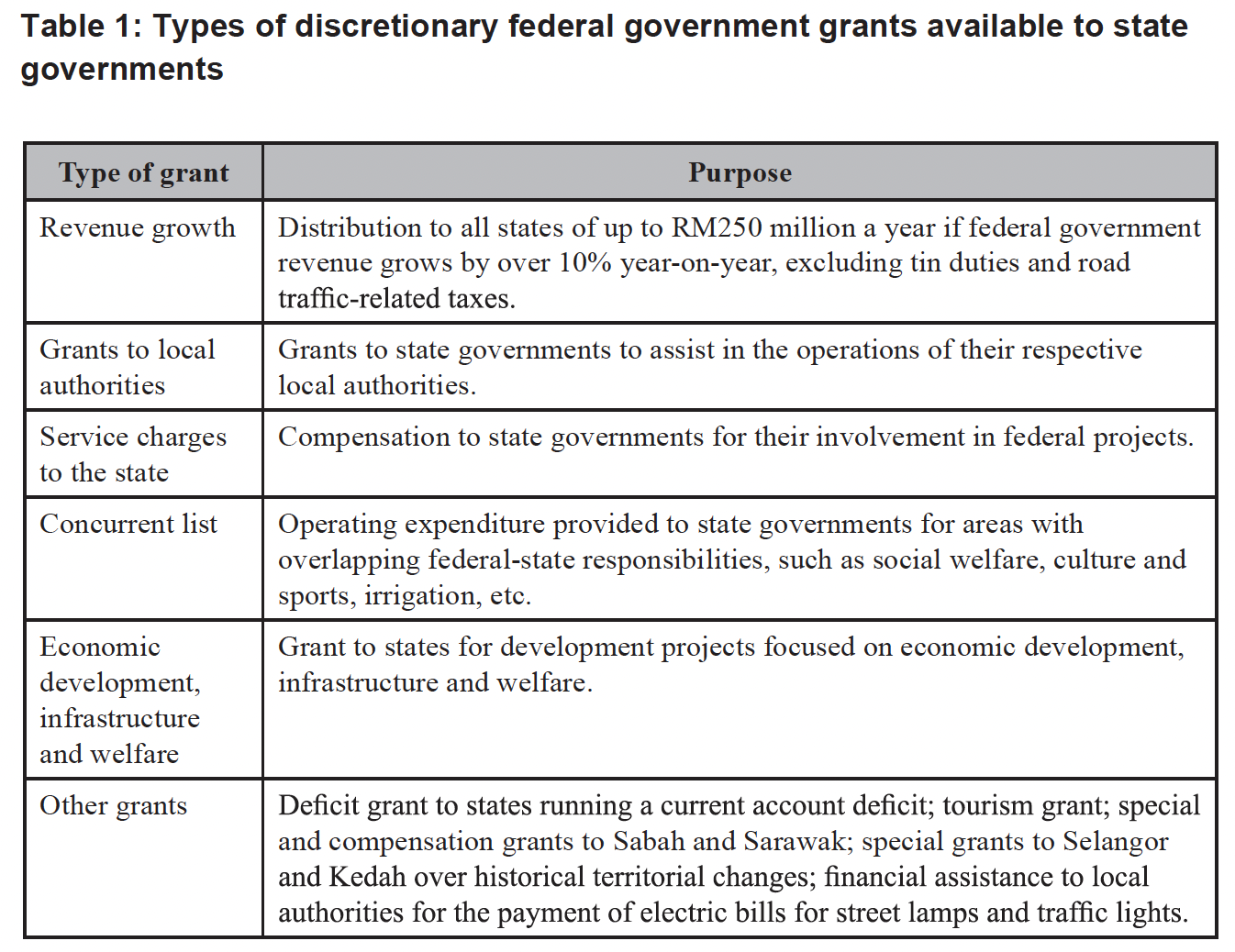
The existing arrangement, as stipulated in Article 109 of the Constitution, is that the federal government must provide two types of funding to state governments: a “capitation grant” (based on population size) and a “state road grant” (for the maintenance of state roads based on total road length). The latter is by far the largest grant given to state governments, making up over 56.9% of the total transfer of funds from the federal government to the states, as of 2024. To be sure, federal money may also be distributed to the states through other grants, as stated in Table 1 below.
The taxes collected are not a zero-sum game. Sharing tax revenue collected in the states will certainly incentivise the states to do more to grow their share of the national economic pie as they would benefit directly from it. This will in turn foster greater federal-state coordination in matters of economic development. The more economic activity generated within a state, the greater the tax revenues for both the state governments and federal government.
With more revenues coming in, states would consequently be able to play a larger role in local policing, education, and healthcare, and possibly even defence. This would put us closer in alignment with Australia and India, which have almost the same constitutional frameworks as Malaysia, where community policing, hospitals and most educational institutions are the domain of the states, and not the federal government. Having a state-level government system in our constitutional structure would now be an obvious blessing which Malaysia should make full use of. The question is whether we can find a new political compact or better a “new deal” to empower the states under Malaysian federalism.
It is time for the federal and state governments to create a Malaysian federalism that is more balanced and just, and that will then contribute to the prosperity and well-being of ordinary Malaysians.
The Future of Federalism
How we arrange and rearrange the institutions of our three-tier government — federal, state and local governments — will remain an important subject with huge implications for Malaysia in the years to come.
We have to first ask ourselves, why do we want to strengthen federalism? Federalism is not necessarily normatively superior to a unitary state. We must avoid devolution for the sake of devolution. Any discussion about local elections without looking at strengthening the state governments’ roles and responsibilities is not helpful in improving democratic governance.
Federalism is a very relevant arrangement to accommodate identity politics within a larger unit of nationhood. But identity politics should not be an end in itself. Federalism, decentralisation and devolution have to come with material benefits in terms of welfare for the people.
Devolution is good only when it makes democracy work better for the people. There are two levels to this:
- First, the type of devolution that should be promoted must facilitate public participation and thus improve democracy at the subnational level. For instance, the authority to manage public transport and environment can be devolved or at least shared between the federal government and the states in the hope that locals (at a more granular level and in a manner more closely tailored to community needs) can participate in the decision-making process. And with rising environmental consciousness, locals hopefully can help monitor environmental degradation better than any central agency.
- Second, devolution must be protected by democratic accountability. There is no point in devolving powers to the states if there are no checks-and-balances in place at the state level to prevent authoritarianism or corruption, for instance, in environment enforcement.
Balancing democratic participation with accountability is crucial in designing what to devolve and what not to devolve. Malaysia is not going to be well served if it swings from a highly centralised system to one that is fragmented by corruption and abuses.
If the point is to organise our society and nation better, whatever we decide to do to rearrange our institutions, we need to ensure that we remove silos in work processes and not add more islands of disconnectedness instead.
Where Do We Start?
As much as many think that Malaysia inherited a British model of governance; to be precise, the Malaysian federalism is very much modelled after the Australian and Indian constitutional arrangements, especially with regards to the following features:
- The states — the UK has no concept of states; the idea of states came from the US;
- The Senate as the House of States — the UK has no concept of a Senate conceived as the House of States; and
- Local governments, whether elected or appointed, are within the purview of states.
The UK was very much a unitary state until devolution in the 1990s. To strengthen federalism in Malaysia, therefore, we may look to the Australian and Indian models for ideas.
In the current institutional arrangements, if the local government is shut down today, the public will soon notice since their garbage is immediately not being collected. But no one would notice that if a state government is shut down.
Back around 2001 when Indonesia was grappling with the question of decentralisation, federalism was an “F” word, something which was disliked and even a taboo. But today, Indonesia is a very decentralised state, for good and for bad. Indonesia was highly centralised and militarised under Suharto and thus it was said that Indonesia had to face the rough waters of decentralisation and build the ship of subnational authorities.
Malaysia does not have that problem. We can work on strengthening the state authorities through devolving roles and responsibilities from the Federal Government and consolidating some local government functions at the state level.
I am among many who have advocated for local elections, but I have always done it with a caveat: local elections should only happen when the roles and functions of the state governments and local authorities are revisited, reorganised and reduced.
By design, the Local Government Act 1976 frames local authorities as an extension of the state governments. Today, however, some local councils in Selangor, Penang and Johor are larger in fiscal size than the Perlis state government and equal to that of Melaka. For example, Majlis Bandaraya Petaling Jaya’s (MBPJ) budgetary allocation for 2026 is RM521.74 million while Penang state government tabled a budget of RM1.088 billion for 2026, nearly triple the state budget of Perlis (RM359.58 million) and even exceeding the estimated operating expenditure of the Melaka state government (RM528.8 million). [2]
If the realignment of local governments can be done so that they are balanced in fiscal, geographical and population size, local elections would then be a good way of improving democratic participation. Otherwise, once we have local elections, state governments will cease to operate in the eyes of the public. This is a very important point which unfortunately often elude those who are for local elections. The debate about local elections in Malaysia is unfortunately often clouded by political and racial undertones, which limits the space for fact-based discussions.
Indonesia was once militantly against federalism and decentralisation very much due to its history during independence when the breakaway of provinces was a perennial worry.
So, history matters. Malaysia’s current institution was very much a creation from 1948. It was structured as a federation to respond to dissatisfaction against the Malayan Union in 1946. But 1948 was also the year during which the Malayan Emergency was declared against the Communists. The police were thus the first full-fledged national body, even before the federal civil service was fully formed.
We can now look at the Australian and Indian federations and see how we can gradually devolve powers in comparable services. For instance, states play a very strong role in Australia and India as far as community policing, health and education are concerned. We can experiment with, for instance, states getting to form some auxiliary police (polis bantuan) units to carry out some policing functions which do not have to be centralised, such as traffic policing. Health and education can also be devolved as much as possible to reduce the fiscal and operational burden on the federal government while empowering state governments to deliver more responsive, targeted, and effective solutions to the communities they serve.
At the same time, we will have to acknowledge that complete devolution is not possible nor desirable. Even in highly decentralised nations such as the US, there is still a need for some form of federal policing.
Of course, states do need to pay for these services if they run them. One of Malaysia’s weaknesses in fiscal arrangement is that states’ revenues come from land and natural resources. So far, debates on federalism still do not go beyond the issue of oil royalty. Just as with other natural resources, it is a lottery and not necessarily good for the environment.
Income tax from individuals and corporations in a particular state can be shared in different proportions subject to new shared roles and responsibilities agreed upon between the Federal Government and the said state.
Finally, national representation of state voices is an important subject which should not be ignored. Both India and Australia designed the Senate as the House of States. India elects its senators through state parliaments while Australia directly elects its representatives to the upper house from every state (each state elects 12 senators for a six-year term on a staggered basis). Meanwhile, Malaysia has three categories of senators: first, 26 to represent 13 states and indirectly elected by a state assembly motion; second, four to represent the federal territories; and third, 40 appointed by the King at the recommendation of the Prime Minister.
My hope is that one day, we will directly elect most of our senators through the ballot boxes, as is the case in Australia. They should represent the interests of their respective states, with Sabah and Sarawak having a higher weightage of perhaps one-third of senators. The campaign for granting Sabah and Sarawak one-third representation should be in the senate and not in the lower house, which should as much as possible represent the one-person one-vote standard.
The discussion of how to rearrange our institutions will continue to dominate headlines, such as discussion on local elections or state nationalism in Sabah or Sarawak. However, it is time for us to look at the issues with fresh eyes and from new perspectives so that we are not captured in clichés, but that we actually move forward one step at a time in the right direction.
Footnotes
[1] This ISSUES is an adapted version of discussions on federalism found in the author’s Second Takeoff: Strategies for Malaysia’s Economic Resurgence, chapters 23 and 24. See reference.
[2] Sources:
Selangor:
https://www.thestar.com.my/metro/metro-news/2026/01/07/budgeting-for-a-balanced-city
Penang:
https://www.bernama.com/en/news.php?id=2490895
Melaka:
https://ww-w.bernama.com/en/general/news.php?id=2500433
You might also like:
![Heritage Tourism in George Town: A Complicated and Always Controversial Issue]()
Heritage Tourism in George Town: A Complicated and Always Controversial Issue
![Counting Candidates: Towards Minimum 30% Women Representation on the Ballot]()
Counting Candidates: Towards Minimum 30% Women Representation on the Ballot
![Eradicating Child Marriages in Southeast Asia: Protecting Children, Challenging Cultural Exceptional...]()
Eradicating Child Marriages in Southeast Asia: Protecting Children, Challenging Cultural Exceptional...
![Key Issues to Consider in Heritage Preservation]()
Key Issues to Consider in Heritage Preservation
![How Tools from the Discipline of History Can Improve Public Policymaking]()
How Tools from the Discipline of History Can Improve Public Policymaking