

EXECUTIVE SUMMARY
- Penang’s federally funded RM16.8 billion Mutiara Light Rail Transit (LRT) Line presents a major opportunity to reshape how the state grows and distributes access to opportunity.
- Transit-oriented development (TOD) can translate rail investment into lasting changes in urban form and travel behaviour. Drawing on TOD experiences of Singapore, Copenhagen and Hong Kong, this paper identifies three characteristics of successful TOD:
- Mixed and concentrated development around stations;
- Genuine access through safe walking routes and feeder connections, and;
- Progressive control of private-vehicle demand once credible alternatives are available.
- The paper also examines land-value capture, redevelopment challenges in mature urban areas and the risk of rising housing costs and displacement. It argues that Penang should integrate station-area development, infrastructure financing, urban renewal, transport-demand management and housing-equity safeguards within a single framework.
- The Mutiara Line’s long-term legacy will depend not only on the railway itself, but on how effectively Penang governs the development and the communities around it.
1. Introduction: Building around the LRT
Construction on Penang’s Mutiara LRT line began in earnest in early 2026. As of August that year, the project delivery partner, MRT Corp, reported that 93% of the land required for the first construction package had been secured (The Vibes, 2026).
The line will run 29.5 kilometres from George Town to Permatang Damar Laut across 21 stations, with a target completion date of December 2031 (Carz.com, 2025c), and a further public review opened in early 2026 on a proposed six-kilometre cross-sea link to Penang Sentral (Carz.com, 2026). At an approved ceiling of RM16.8 billion, it is unambiguously the most consequential public investment the state has made in a generation.
Yet infrastructure investment of this scale, while necessary, is insufficient on its own to reshape urban mobility towards greater public transport use and reduced dependence on private vehicles. A substantial body of transport-geography literature documents cases in which heavy rail investment failed to alter travel behaviour or urban form because land use around stations remained car-oriented, such as surface parking, low-density sprawl, and roads that treat pedestrians as an afterthought (Knowles et al., 2020).
The mechanism by which rail investment translates into behavioural and spatial change is known as “transit-oriented development” (TOD): the deliberate integration of land use and transport planning around transit nodes (Calthorpe, 1993; World Bank, n.d.). Absent this integration, a rail line functions as an expensive parallel option alongside an otherwise unreformed car-dominated city.
This paper makes two contributions: it synthesises the conceptual TOD literature into testable policy conditions; and it derives policy recommendations for station-area development along the Mutiara Line, engaging honestly with the equity risks, principally gentrification, which TOD can generate if left unmanaged. Building the LRT is important. Even more important is what we build around it.
2. Characteristics of successful TOD
The World Bank defines TOD as compact, mixed-use, pedestrian-friendly development concentrated around mass transit, which brings housing, jobs, services, and amenities within convenient reach of stations (World Bank, n.d.). Popularised by Peter Calthorpe (1993), TOD combines higher-density development with strong commercial and employment activity along major transit corridors.
Later scholarship identifies several recurring features: walkable station access, connected pedestrian networks, mixed land use, high-frequency transit, dense urban form, and active management of road-traffic demand (Knowles et al., 2020). Together, these reflect the broader principle of land use and transport integration.
More recent research adds an equity dimension through the “node-place-people” framework, which assesses a station’s network connectivity, the intensity and mix of surrounding development, and who can actually access and afford it (Zhao et al., 2024). This matters because successful TOD should be judged not only by density and connectivity, but also by how its benefits are distributed.
From this literature, three characteristics can be used to distinguish genuine TOD from conventional development located near a railway.
Characteristic 1: High concentration of people and activity
Residential density alone is an insufficient indicator. For example, a cluster of high-rise towers surrounded by arterial roads and surface parking may register as dense on a population-per-hectare basis while remaining functionally car-dependent, since residents must still drive for most errands.
What matters is the co-location of housing with employment, retail, healthcare, education, and civic amenities within a walkable catchment. The World Bank’s implementation guidance identifies roughly 800 metres, approximately a ten-minute walk, as the effective catchment radius within which mixed land use meaningfully reduces trip distances (World Bank, 2018).
Characteristic 2: Genuine orientation toward transit
A nearby station is not truly accessible if reaching it means navigating unsafe crossings, exposed walkways, and degraded footpaths. This condition carries particular force in Penang’s climate: the state’s average monthly rainfall of approximately 205 millimetres is nearly three times Amsterdam’s and more than four-and-a-half times Copenhagen’s, and Penang’s driest month typically receives more rainfall than Copenhagen’s wettest (Weather Atlas, as cited in Woo, 2020).
This single climatic fact should discourage any assumption that Penang can adopt the cycling-centred TOD models common in northern Europe; the relevant design response is sheltered, shaded pedestrian infrastructure and dense feeder-bus coverage rather than cycling infrastructure per se.
It is notable that Penang’s feeder network shows early, if modest, signs of behavioural response even ahead of rail: average daily bus ridership across the state exceeded 46,000 by May 2025, following the introduction of on-demand van services and free travel on selected routes (Carz.com, 2025b).
Characteristic 3: Controlled private-vehicle demand
A government cannot continue making driving cheap and parking abundant, then expect people to abandon private vehicles for public transport. Singapore provides perhaps the clearest regional example of how this can be done. Its car-lite strategy does not rely on rail investment alone. It combines an extensive public transport network with walking and cycling infrastructure, while deliberately managing demand for private cars. Between 2016 and 2022, the share of peak-period journeys made through Walk-Cycle-Ride modes rose from 71% to 74%, while the share made by driving fell from 29% to 26% (Ministry of Transport [MOT], 2024).
This outcome reflects deliberate policy choices. Singapore reinforces its public-transport strategy by deliberately making private car ownership and use costly. It caps vehicle growth through the Vehicle Quota System and requires motorists to obtain a Certificate of Entitlement (COE), which gives the owner the right to use the vehicle for 10 years (Land Transport Authority [LTA], 2026a). Category A generally covers smaller and lower-powered cars, while Category B covers larger or more powerful vehicles.
In the second COE bidding exercise of August 2026, premiums reached S$128,501 for Category A and S$131,001 for Category B (LTA, 2026b). At S$1 = RM3.18791, this is approximately RM409,650 and RM417,619 respectively. These amounts purchase only the COE. Buyers must still pay for the vehicle itself, a registration fee, excise duty of 20% of the vehicle’s Open Market Value, and the Additional Registration Fee (ARF), which rises progressively from 100% to as high as 320% of the relevant portion of the vehicle’s value (LTA, 2026c).
The costs continue after a car is purchased. Singapore uses Electronic Road Pricing (ERP) to charge motorists for using congested roads at particular times, with rates adjusted according to traffic conditions. From 29 June 2026, for example, some morning ERP charges reached S$5 for a passenger car on the Ayer Rajah Expressway towards the city, while other priced expressway segments carried varying charges depending on time and congestion (LTA, 2026d).
Parking is similarly treated as a scarce resource rather than a heavily subsidised entitlement. At HDB estates, resident season parking generally costs S$80 a month for surface parking and S$110 for sheltered parking, while second cars and non-residents can face substantially higher charges, reaching S$190 a month for sheltered parking in restricted zones. Short-term HDB parking within the Central Area costs S$1.20 per half-hour during daytime hours, equivalent to S$2.40 an hour (HDB, 2026a; HDB, 2026b). Commercial parking in central business and shopping districts can cost considerably more.
Fuel adds another significant operating cost. Singapore does not subsidise petrol for motorists in the manner historically practised in Malaysia, leaving pump prices much more exposed to market prices and fuel taxation. On 23 June 2026, 95-octane petrol was selling at S$3.42 per litre across the major operators before loyalty and credit-card discounts. At S$1 = RM3.18791, this was approximately RM10.90 per litre, compared with substantially cheaper subsidised fuel (RM1.99 per litre of RON95) available to eligible Malaysian motorists (The Straits Times, 2026).
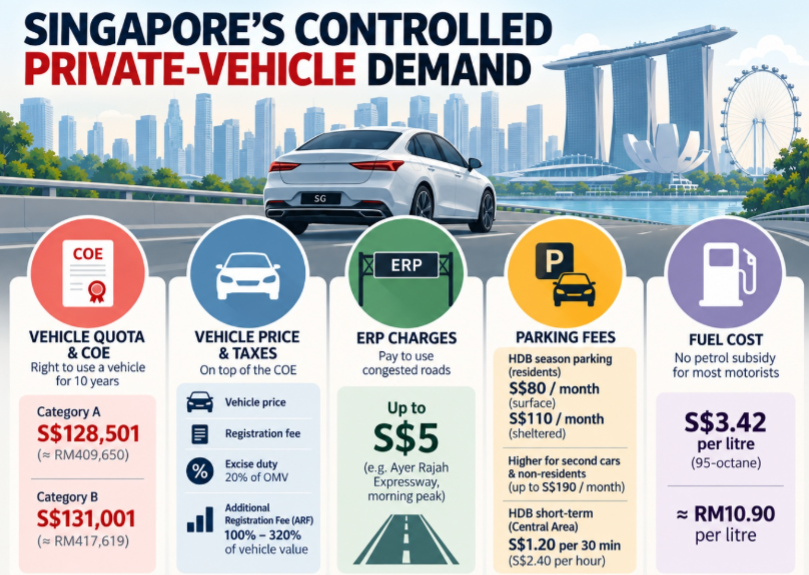
Singapore therefore restrains car use through a mutually reinforcing system: high acquisition costs, vehicle quotas, progressive registration taxes, road pricing, recurring parking charges and high fuel costs.
Singapore simultaneously strengthens the alternative to driving. Over the decade leading to 2024, its rail network expanded by approximately 40%, accompanied by continued investment in first- and last-mile walking and active-mobility infrastructure (MOT, 2024). In 2023, public buses carried an average of 3.747 million passenger trips per day, the MRT 3.243 million, and the LRT 202,000, producing a combined average of approximately 7.19 million daily public transport trips (LTA, 2025).
Providing an extensive and attractive public transport network is unlikely, by itself, to produce a major modal shift if private-vehicle demand remains largely unconstrained.
The Klang Valley illustrates this problem. It is served by multiple LRT and MRT lines, the Monorail, KTM Komuter, BRT, Rapid KL buses and demand-responsive transit services. Yet public transport accounted for only 25.9% of modal share in 2024, well below the government’s 40% target for 2030 (Ministry of Economy, 2025).
Singapore demonstrates the other side of the equation. Its extensive rail and bus network is reinforced by policies that actively constrain private-car ownership and use. In 2024, mass public transport accounted for 66% of peak-period motorised journeys, while its broader Walk-Cycle-Ride share had already reached 74% in 2022 (Ministry of Transport, 2024, 2025).
The comparison suggests that infrastructure provision and demand management must work together. Expanding public transport increases the attractiveness of the alternative, while controlling private-vehicle demand changes the relative cost and convenience of driving.
The policy lesson is important for transit-oriented development. A government cannot make driving cheap and parking abundant while expecting a durable shift towards public transport. Singapore makes public transport attractive while ensuring that motorists bear much more of the economic cost of scarce road space. A credible car-lite strategy requires both sides of the equation. Public transport must become increasingly convenient, accessible and attractive, while the financial and spatial advantages associated with private-car use must be actively managed.
Penang’s fiscal, geographic, and federal constraints make direct replication of Singapore’s vehicle-quota system implausible, but the underlying principle, that transport-demand policy and land-use policy cannot be planned separately, is transferable regardless of jurisdiction.
3. TOD financing models
Urban rail is capital-intensive, and one of TOD’s key fiscal advantages is its potential to help finance this investment through land value capture. This involves recovering, through land sales, leases, development charges or similar mechanisms, a share of the increase in land value created by improved transit accessibility, and then reinvesting those gains in the transit system (World Bank, 2015). Three case studies illustrate different institutional approaches to this model.
Case study 1: Punggol Town Centre, Singapore
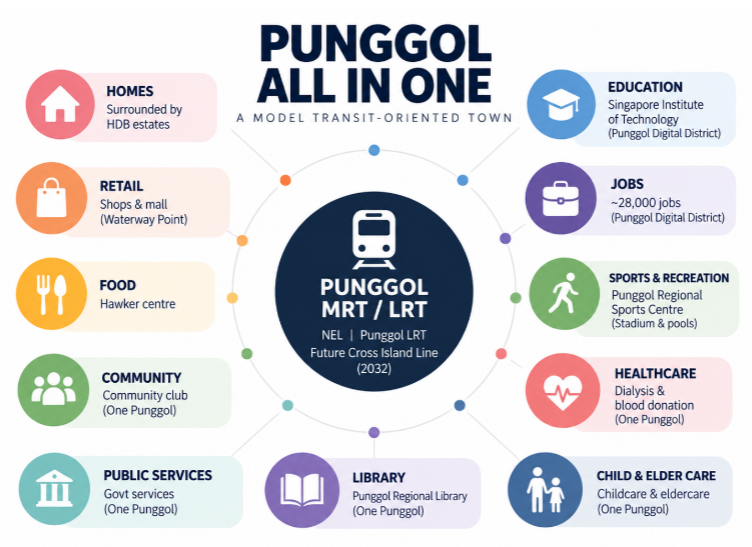
At the neighbourhood scale, Singapore offers one of the region’s more fully realised examples of integrated TOD in Punggol Town Centre. Its strength lies in the deliberate concentration of transport, housing, retail, public services, recreation, and employment functions around a connected rail network.
Punggol MRT/LRT station connects the North East Line, which provides direct access to central Singapore, with the Punggol LRT network, which distributes passengers across surrounding public housing estates that a conventional linear rail alignment would serve less effectively. By 2032, the interchange is expected to gain a third connection through the Cross Island Line (Land Transport Guru, 2026).
The station sits within a dense residential and commercial precinct, with major retail and housing developments concentrated around the transport interchange. The wider town centre is also surrounded by extensive public housing estates, giving the precinct a substantial residential population within reach of the rail network.
Around this transport, retail and housing core are several major civic and community functions. One Punggol, an integrated community hub opened in October 2022 on a 2.8-hectare site, brings together a community club, public-service facilities, a regional library, hawker centre, childcare and eldercare services, a blood-donation centre and a kidney-dialysis facility (BYKidO, 2022). Its significance lies in how it complements the wider precinct rather than functioning as the precinct in itself.
The same logic extends to recreation and employment. The Punggol Regional Sports Centre is scheduled to open in 2026 with a 5,000-seat stadium and five swimming pools (Ministry of Culture, Community and Youth, 2024; The Smart Local, 2026). Further north, the newly opened Punggol Coast MRT station serves the 50-hectare Punggol Digital District, which will combine the Singapore Institute of Technology campus with technology firms including Boston Dynamics and is expected to support about 28,000 jobs (Urban Redevelopment Authority, n.d.).
Singapore’s TOD model is also underpinned by a long-standing financing and sequencing strategy. During the construction of the original Mass Rapid Transit system in the 1980s, land sales generated billions in public revenue that helped support infrastructure investment (Centre for Liveable Cities, 2014). That broader logic remains visible in the Cross Island Line, which is planned as Singapore’s longest fully underground rail line, with an eastern branch serving Punggol and a later phase extending towards the Jurong Lake District (LTA, 2026e; SGTrains, 2026).
The recurring principle across both periods is sequencing. Transit capacity is provided in anticipation of future development and population growth, allowing land use, housing, employment and community facilities to be organised around the network from the outset rather than retrofitted after urbanisation has already taken place.
Case study 2: Copenhagen, Denmark
Copenhagen demonstrates how transit planning, urban development and infrastructure finance can reinforce one another. Under the 1947 Finger Plan, development followed railway lines like the fingers of a hand, while the spaces between those fingers remained green. This limits continuous urban sprawl and keeps nature accessible to residents (Knowles, 2012; OECD, 2009).
Ørestad applied this principle through an integrated financing model. In 1992, Denmark approved both the new district and the Copenhagen Metro. The Ørestad Development Corporation received approximately 310 hectares of public land. The City of Copenhagen owned 55% of the corporation and the Danish state owned 45%. The corporation borrowed from capital markets to build the metro and prepare the land for development. Copenhagen and the state assumed joint liability for the debt, strengthening its creditworthiness. Once the area had been rezoned, connected and serviced, development sites were sold at higher market values. The proceeds helped repay infrastructure debt (OECD, 2007, 2009).
This was land value capture through public land ownership. The increase in value came from a combination of rezoning, site preparation, public amenities, transport access and market demand. By the end of fiscal year 2006, land sales had generated DKK 4.6 billion, while outstanding debt stood at DKK 13.7 billion. The experience also revealed substantial risks. Land prices initially rose by only 10% to 15%, against a projected 100%, while metro construction faced delays and cost overruns. Sales subsequently accelerated as development progressed (Peterson, 2009).
Copenhagen later added a targeted metro fee. Under the City & Port development framework, properties within 50 metres of a new station can be charged an annual property-based levy for 60 years. This allows part of the benefit received by nearby property owners to support infrastructure investment (OECD et al., 2022).
Copenhagen’s central lesson is clear. Publicly controlled land can generate revenue for transport infrastructure when transit, zoning and development are planned together. Its success still depends on strong public credit, property demand, careful sequencing and effective cost control.
Case study 3: Hong Kong, China
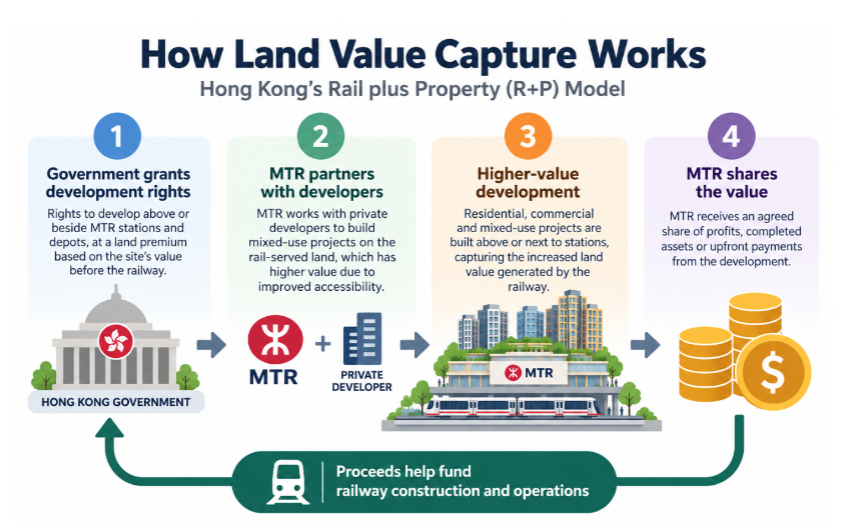
Hong Kong’s Rail plus Property (R+P) approach is one of the most extensively documented examples of development-based land-value capture and offers an important equity lesson for Penang. For qualifying railway projects, the Hong Kong government grants MTR Corporation development rights above or beside Mass Transit Railway stations and depots at a land premium based on the site’s value without the proposed railway. MTR then partners with private developers using the higher, rail-served value and receives an agreed share of profits, completed assets, or upfront payments. These proceeds are intended to close the project-specific gap between expected railway costs and revenues (Cervero & Murakami, 2009; Government of the Hong Kong Special Administrative Region [HKSAR Government], 2021; Suzuki et al., 2015).
The model has generated substantial, variable commercial returns. MTR’s profit attributable to shareholders increased from HK$7.784 billion in 2023 to HK$15.772 billion in 2024, a rise of 102.6%. Property-development profit climbed from HK$2.083 billion to HK$10.265 billion, while recurrent-business profit rose from HK$4.281 billion to HK$7.210 billion. A HK$1.703 billion loss from investment-property revaluation partly offset these gains. In 2025, attributable profit eased to HK$14.677 billion, representing a 6.9% decline (MTR Corporation Limited, 2025, 2026).
MTR also remains central to Hong Kong’s transport system. In 2024, it carried approximately 5.18 million of the territory’s 11.7 million daily public-transport journeys, equivalent to about 44.3%. Its heavy-rail network recorded 99.9% train-service delivery and passenger journeys on time (MTR Corporation Limited, 2025; Transport Department, 2025). MTR’s investment commitments involve separate timeframes: more than HK$65 billion was allocated to railway maintenance and asset renewal for 2023–2027, while more than HK$100 billion was committed to new railway projects over the coming years (MTR Corporation Limited, 2023, 2024).
R+P’s financing logic also creates distributional pressure. The Hong Kong government has acknowledged that R+P sites were generally used for private housing to maximise site value and bridge railway funding gaps. Allocating part of a site to subsidised housing reduces the property profit available to finance the railway (HKSAR Government, 2021).
Peer-reviewed evidence reinforces the wider equity concern. Liang et al. (2022) estimated that MTR development between 2002 and 2004 increased the number of residents with bachelor’s degrees or higher by 10% in the New Territories and 7.81% in new towns. The number of low-income households fell by 5.85% and 7.53%, respectively. Their household-level analysis indicated that highly educated residents moved into MTR-served areas while low-income households moved out.
Housing pressure remains substantial. As of June 2026, Hong Kong had approximately 100,500 general public-rental-housing applications and another 81,000 applications from non-elderly single people under the Quota and Points System. General applicants housed in standard public rental housing during the preceding 12 months had waited an average of 5.5 years (Housing Bureau, 2026).
The combined findings nevertheless show why Penang should integrate binding affordable-housing requirements, public amenities, transparent value-sharing arrangements, and anti-displacement measures into station-area development before improved accessibility raises surrounding land values.
4. Policy implications for Penang LRT
Penang does not possess Singapore’s extensive public land holdings, Copenhagen’s distinctive fiscal and institutional foundations, or Hong Kong’s extraordinary population density. It does, however, retain significant authority over land use, which falls largely within state jurisdiction under Malaysia’s constitutional framework.
Its ability to finance major transport infrastructure is more constrained because most major sources of taxation and revenue remain concentrated at the federal level (Yeoh, 2019). The Mutiara Line itself illustrates this dependence: the project is being delivered within a federally funded budget ceiling of RM16.8 billion (Carz.com, 2025a). Penang therefore cannot simply replicate the models of Singapore, Copenhagen or Hong Kong. It must adapt their underlying principles to its own institutional and fiscal realities. Three recommendations follow.
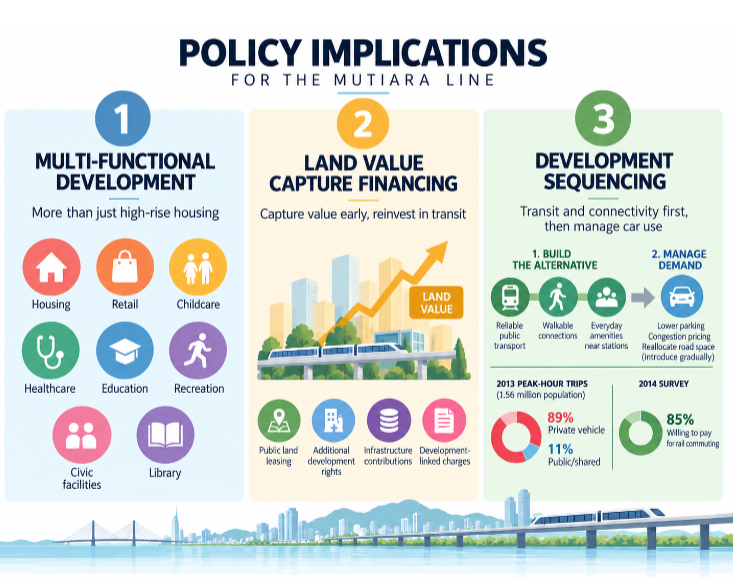
Multi-functional built environment
First, LRT station-area density should be functionally mixed, rather than simply high. Punggol shows that dense residential development becomes more liveable and attractive when housing is combined with childcare, healthcare, education, retail, recreation, and civic facilities.
Density alone is insufficient. High-rise housing concentrated along a major road may produce large numbers of units, but it does not necessarily create an effective TOD catchment if residents still need to drive for everyday needs or face poor walking access to transit (World Bank, 2018).
This also has a demographic dimension. OECD research suggests that affordable childcare and broader family-support policies can reduce the practical and financial burdens of raising children, although fertility outcomes are shaped by many wider social and economic factors (Fluchtmann et al., 2023).
Financing transit development
Second, land value capture should be built into station-area planning before confirmed transit improvements are fully capitalised into surrounding land prices. With the Mutiara Line alignment and the proposed cross-sea connection to Penang Sentral now under public review (Carz.com, 2026), Penang has an important opportunity to establish value-capture mechanisms early.
These could include public land leasing, the sale of additional development rights, infrastructure contributions, or other development-linked charges. Embedding such mechanisms before major rezoning and land transactions occur would give the state a better chance of capturing part of the value created by public investment.
Development sequencing
Third, sequencing is critical. Measures that make private-car use less attractive, such as lower parking requirements, congestion pricing, or the reallocation of road space, can generate substantial political resistance if introduced before residents have a credible alternative.
The more defensible sequence is to establish reliable public transport, safe and sheltered walking routes, effective first- and last-mile connections, and everyday amenities near stations first. Demand-management measures can then be introduced progressively once residents have experienced a practical alternative to driving.
Penang’s historical baseline shows the scale of this challenge. A 2013 state survey estimated that, of roughly 225,000 peak-hour trips made by a population of 1.56 million, about 89% were by private vehicle and only 11% were by shared or public transport (Pejabat Setiausaha Kerajaan Negeri Pulau Pinang, 2013).
A 2014 survey found that 85% of respondents expressed willingness to pay for rail commuting (Lee & Cheah, 2014). This suggests that Penang’s central challenge may lie less in persuading people that public transport is desirable and more in providing a system that is sufficiently reliable, connected, convenient, and competitive with private-car travel.
5. Democratic will for TOD
The three conditions for successful TOD, high-density development, strong public transport investment, and controlled private-vehicle demand, are difficult to create simultaneously. They require substantial resources, institutional capacity, and, above all, sustained public support.
Failures to shift a city from car dependence towards public transport are often attributed to a lack of “political will”. In a democracy, however, that explanation is incomplete. Elected governments operate within the preferences and tolerances of the electorate. If a large share of the public rejects higher-density living, opposes major spending on public transport, or resists higher parking charges, road pricing and other measures that make private-vehicle use costlier, governments face real political constraints in pursuing such policies.
Successful TOD therefore requires more than political will. It requires democratic will: sufficient and sustained public acceptance of the trade-offs involved in changing how a city grows and how people travel.
This is why development sequencing is pivotal. In Penang, where private-vehicle ownership is deeply embedded and fuel remains relatively affordable, an abrupt transition from a car-oriented city to a transit-oriented one would risk strong public resistance. The transition must instead be phased. Public transport capacity, feeder services, safe walking infrastructure and mixed-use station areas should be strengthened progressively, giving residents credible alternatives before stronger measures to manage car use are introduced.
Such a transformation may take decades. What matters is that each phase is deliberately timed so that the benefits of the next stage become visible before its costs and constraints are imposed. TOD is therefore not simply a planning model. It is a long-term process of building both the urban infrastructure and the democratic consent required to sustain it.
6. Redevelopment of matured areas
The Mutiara LRT will run through some of Penang’s oldest and most densely developed areas. Land around many stations is already occupied by homes, shops, apartments and other buildings. To create effective transit-oriented development (TOD), Penang may therefore need to redevelop some existing brownfield areas.
The key legal issue needs to be clearly understood. Penang already has the power to acquire land and control development. The greater challenge is redeveloping areas where land and buildings are owned by many different people.
Under the Land Acquisition Act 1960, the State Authority can acquire land for public purposes and other purposes allowed under the Act. Article 13 of the Federal Constitution also states that property can only be acquired in accordance with law and with adequate compensation.
At the same time, land use and development are regulated through laws such as the National Land Code and the Town and Country Planning Act 1976, primarily through the State Planning Committee and local planning authorities.
The biggest challenge arises with ageing apartments and other strata properties. Under the Strata Titles Act 1985, voluntary termination of a strata scheme for demolition generally requires unanimous consent. This means that redevelopment can be difficult when even one or a small number of owners do not agree.
The proposed Urban Renewal Bill 2025 sought to create a new framework for urban renewal, including alternative consent thresholds. However, the Bill has not yet become law.
The challenge for Penang is therefore not whether it has the power to acquire land for the LRT or other public purposes. The challenge is how to redevelop mature areas with many different property owners in a way that is fair, efficient and legally sound. Any future framework for TOD-led urban renewal should make redevelopment easier while protecting property rights. It should provide clear rules on compensation, relocation, and rehousing of existing residents.
7. Building housing equity into the design
Land value capture relies on recovering part of the increase in land and property values generated by transport investment. Around new stations, the same appreciation can raise rents and sale prices, attract higher-income households, and place existing residents and small businesses under pressure. Penang should therefore treat displacement risk as a central consideration when designing a transit-financing framework based on station-area development (Delmelle, 2021; Suzuki et al., 2015).
Padeiro et al. (2019) reviewed 35 quantitative studies published between 2000 and 2018. They found some evidence of transit-induced gentrification, while methodological weaknesses limited many causal conclusions. Their review linked neighbourhood change to local market conditions, existing built-environment characteristics, and accompanying public policies as well as transit development. A later thematic review identified transit-induced gentrification as one of the principal justice concerns surrounding TOD and emphasised greater protection and participation for disadvantaged groups (Yip et al., 2024).
Recent empirical studies have identified credible displacement risks in particular metropolitan contexts. In Hong Kong, Liang et al. (2022) used difference-in-differences and household-level models to examine areas served by new MTR lines. Their reported estimates showed increases of 10% in the share of degree-educated residents in the New Territories and 7.81% in new towns. The estimated share of low-income households fell by 5.85% and 7.53% in those respective areas. Household-level findings also indicated that more highly educated residents moved into MTR-served neighbourhoods while low-income households moved out.
Evidence from Shanghai strengthens this concern. Using a difference-in-differences design and individual rental records, Deng et al. (2025) found significant rent increases within 1.8 kilometres of newly opened metro stations during the following year. Renters living within station catchment areas were more likely to relocate farther from metro stations, the city centre, and their workplaces. Incoming residents generally had higher socioeconomic status. These findings demonstrate a credible displacement pathway without implying that every transit project will produce the same result.
Other studies illustrate how transport and housing policies shape outcomes. Lin et al. (2024) found a positive direct association between TOD intensity and transit mode share in gentrifiable Taipei neighbourhoods. Their model also identified a potential indirect pathway in which gentrification, combined with rising car ownership, could offset part of the ridership benefit. In the New York metropolitan region, Chen et al. (2023) found that transit deserts were concentrated in disadvantaged neighbourhoods and that transit service had a statistically significant association with gentrification.
Hong Kong also exposes an important tension in rail-property financing. In 2021, the Hong Kong government explained that Rail plus Property sites had generally been developed as private housing to maximise site value and bridge railway-funding gaps. Allocating such sites to subsidised housing would reduce the property proceeds available for rail construction (HKSAR Government, 2021). These facts show that a commercially productive rail-property model can coexist with severe housing pressure and create incentives favouring higher-value private development.
For Penang, housing-equity protections should be enacted alongside any land value capture mechanism. Station-area redevelopment rules should establish an enforceable affordable-housing requirement, protect existing tenants, support affected small businesses, and reserve a defined share of captured value for affordable housing and public amenities. Public authorities should monitor rents, property prices, tenure changes, and residential movement from the announcement of each project onward.
Metropolitan parking, road-pricing, and vehicle-ownership policies should reinforce the transit investment where local evidence indicates rising car ownership. Embedding these safeguards in the original legislation would give Penang a stronger chance of distributing the benefits of improved accessibility across income groups.
8. Conclusion
The Mutiara Line can become the backbone of a more connected, productive and inclusive Penang only if the railway is planned together with the land, communities and development around it. Rail creates accessibility. TOD determines whether that accessibility changes how people live, travel and access opportunity.
This paper identifies three conditions for successful TOD: mixed and concentrated activity around stations; safe, sheltered walking routes and effective feeder connections; and progressive management of private-vehicle demand once credible alternatives are available.
The experiences of Punggol, Copenhagen and Hong Kong show how transport, land development and finance can reinforce one another, while also revealing the risks of market failure, rising housing costs, and displacement.
Penang must adapt these lessons to its own circumstances. Its fiscal capacity is constrained, while many stations will serve mature areas with fragmented ownership and ageing strata properties. Effective TOD will therefore require five connected priorities: multi-functional station neighbourhoods, early land-value capture, workable and fair urban-renewal mechanisms, carefully sequenced management of car use, and enforceable protections for affordable housing, tenants and small businesses.
Ultimately, TOD is a question of governance as much as urban design. It requires coordination across transport, land, finance, housing and social policy, supported by public confidence that the transition is practical and fair.
Building the Mutiara Line is the infrastructure project. Governing Penang’s growth around it is the generation-defining task.
References
BYKidO. (2022, October 10). One Punggol: The new integrated Punggol community hub. https://www.bykido.com/blogs/playgrounds-and-more/one-punggol-the-new-integrated-punggol-community-hub
Calthorpe, P. (1993). The next American metropolis: Ecology, community, and the American dream. Princeton Architectural Press.
Carz.com. (2025a, May 22). Penang bus ridership now exceeds 46,000 daily. https://www.carz.com.my/2025/05/penang-bus-ridership-now-exceeds-46000-daily
Carz.com. (2025b, August 21). MRT Corp justifies RM16.8b Penang LRT budget. https://www.carz.com.my/2025/08/mrt-corp-justifies-rm168b-penang-lrt-budget
Carz.com. (2025c, November 19). Penang Mutiara LRT construction kicks off Jan 2026. https://www.carz.com.my/2025/11/penang-mutiara-lrt-construction-kicks-off-jan-2026
Carz.com. (2026, February 23). Public review opens for revised Penang Mutiara LRT with cross-sea link at core. https://www.carz.com.my/2026/02/public-review-opens-for-revised-penang-mutiara-lrt-with-cross-sea-link-at-core
Centre for Liveable Cities. (2014). Financing a city: Developing foundations for sustainable growth. CLC Publications. https://knowledgehub.clc.gov.sg/publications-library/financing-a-city-developing-foundations-for-sustainable-growth/
Cervero, R., & Murakami, J. (2009). Rail and property development in Hong Kong: Experiences and extensions. Urban Studies, 46(10), 2019–2043. https://doi.org/10.1177/0042098009339431
Chee, H. T. (2024, March 5). Speech by Minister for Transport, Mr Chee Hong Tat, at the Ministry of Transport Committee of Supply Debate. Ministry of Transport, Singapore. https://www.mot.gov.sg/news-resources/newsroom/speech-by-minister-for-transport-mr-chee-hong-tat-at-the-ministry-of-transport-committee-of-supply-debate/
Chen, Y., Xi, H., & Jiao, J. (2023). What are the relationships between public transit and gentrification progress? An empirical study in the New York–Northern New Jersey–Long Island areas. Land, 12(2), Article 358. https://doi.org/10.3390/land12020358
Cheng, L. (2020, March 10). Hong Kong government plans to build 9,000 public housing flats on land near Kam Sheung Road MTR station. South China Morning Post. https://www.scmp.com/news/hong-kong/society/article/3074501/hong-kong-government-plans-build-9000-public-housing-flats
Delmelle, E. C. (2021). Transit-induced gentrification and displacement: The state of the debate. Advances in Transport Policy and Planning, 8, 173–190. https://doi.org/10.1016/bs.atpp.2021.06.005
Deng, K. K., Li, L., & Chen, J. (2025). Impact of public investment on residential gentrification: Individual-level evidence from Shanghai’s rail transit expansion. Urban Studies, 62(11), 2328–2347. https://doi.org/10.1177/00420980241310366
Dim Sum Daily. (2025, January 2). MTR carries over 5 million passengers daily in 2024 with 99.9% punctuality rate. https://www.dimsumdaily.hk/mtr-carries-over-5-million-passengers-daily-in-2024-with-99-9-punctuality-rate/
Fluchtmann, J., van Veen, V., & Adema, W. (2023). Fertility, employment and family policy: A cross-country panel analysis. OECD Social, Employment and Migration Working Papers, No. 299. OECD Publishing. https://doi.org/10.1787/326844f0-en
Government of the Hong Kong Special Administrative Region. (2021, July 14). LCQ3: Developing topside properties at railway stations. https://www.info.gov.hk/gia/general/202107/14/P2021071400527p.htm
Housing Bureau, Government of the Hong Kong Special Administrative Region. (2026). Composite waiting time for subsidised rental housing. Retrieved September 6, 2026. https://www.hb.gov.hk/eng/publications/housing/cwt/index.html
Housing & Development Board [HDB]. (2026a). Apply for season parking. https://www.hdb.gov.sg/parking/applying-for-season-parking/apply-for-season-parking
Housing & Development Board [HDB]. (2026b). Short-term parking charges. https://www.hdb.gov.sg/parking/other-parking-matters/shortterm-parking/shortterm-parking-charges
Katz, B., & Nowak, J. (2018, January 12). How a dying city transformed into one of the wealthiest in the world. The New Localism. https://www.thenewlocalism.com/research/how-a-dying-city-transformed-into-one-of-the-wealthiest-in-the-world/
Knowles, R. D. (2012). Transit oriented development in Copenhagen, Denmark: From the Finger Plan to Ørestad. Journal of Transport Geography, 22, 251–261. https://doi.org/10.1016/j.jtrangeo.2012.01.009
Knowles, R. D., Ferbrache, F., & Nikitas, A. (2020). Transport’s historical, contemporary and future role in shaping urban development: Re-evaluating transit oriented development. Cities, 99, Article 102607. https://doi.org/10.1016/j.cities.2020.102607
Land Transport Authority. (2025). Public transport ridership: Average daily ridership by year, 2015–2024. Government of Singapore. https://www.lta.gov.sg/content/dam/ltagov/who_we_are/statistics_and_publications/statistics/pdf/PT_Ridership_Yearly_2015-2024.pdf
Land Transport Authority [LTA]. (2026a). Certificate of Entitlement (COE). https://onemotoring.lta.gov.sg/content/onemotoring/home/buying/upfront-vehicle-costs/certificate-of-entitlement–coe-.html
Land Transport Authority [LTA]. (2026b). COE bidding results, second bidding exercise, August 2026. https://onemotoring.lta.gov.sg/content/onemotoring/home/buying/coe-open-bidding.html
Land Transport Authority [LTA]. (2026c). Vehicle tax structure. https://onemotoring.lta.gov.sg/content/onemotoring/home/buying/upfront-vehicle-costs/tax-structure.html
Land Transport Authority [LTA]. (2026d). Revised ERP rates from 2 June 2026. https://www.lta.gov.sg/content/ltagov/en/newsroom/2026/5/news-releases/revised-erp-rates-2-jun-26.html
Land Transport Authority [LTA]. (2026e). Cross Island Line. Government of Singapore. https://www.lta.gov.sg/content/ltagov/en/upcoming_projects/rail_expansion/cross_island_line.html
Land Transport Guru. (2026). Punggol MRT/LRT Station. https://landtransportguru.net/punggol-station/
Lee, L. Y., & Cheah, Y. K. (2014). Willingness-to-pay for monorail services: Case study in Penang, Malaysia. Pertanika Journal of Social Sciences & Humanities, 22(1), 165–179. https://repo.uum.edu.my/id/eprint/16842/
Liang, C., Huang, Y., Yip, T. L., & Li, V. J. (2022). Does rail transit development gentrify neighborhoods? Evidence from Hong Kong. Transportation Research Part A: Policy and Practice, 155, 354–372. https://doi.org/10.1016/j.tra.2021.11.022
Lin, J.-J., Lin, T.-Y., Kadali, B. R., & Subbarao, S. S. V. (2024). Association of transit-oriented development with transit use: Effects of gentrification and spatial autocorrelation. Transport Policy, 158, 42–50. https://doi.org/10.1016/j.tranpol.2024.09.004
Metroselskabet. (2023, March 28). Track laying is complete on the M4 Sydhavn. https://metroselskabet.dk/en/contact-and-press/press/press-releases/track-laying-is-complete-on-the-m4-sydhavn/
Metroselskabet. (2025, July 1). Hurray! The M4 line to Sydhavn turns 1 year. https://m.dk/en/travel-with-the-metro/explore-copenhagen/urban-highlights/hurray-the-m4-line-to-sydhavn-turns-1-year/
Metroselskabet. (2026, June 18). Fælles tidsplan for byudvikling og metro i Ydre Nordhavn [Joint timetable for urban development and the metro in Outer Nordhavn]. https://metroselskabet.dk/da/kontakt-og-presse/nyheder/faelles-tidsplan-for-byudvikling-og-metro-i-ydre-nordhavn/
Ministry of Culture, Community and Youth, Singapore. (2024, November 11). Rescheduling of the opening of Punggol Regional Sport Centre to 2026. https://www.mccy.gov.sg/about-us/news-and-resources/rescheduling-of-the-opening-of-punggol-regional-sport-centre-to-2026/
Ministry of Transport, Singapore. (2024, August 5). Opening address by Mr Chee Hong Tat, Minister for Transport and Second Minister for Finance, at the MOT Family Scholarship Award Ceremony. https://www.mot.gov.sg/news-resources/newsroom/opening-address-by-mr-chee-hong-tat–minister-for-transport–second-minister-for-finance–at-the-mot-family-scholarship-award-ceremony/
MTR Corporation Limited. (2023). Interim report 2023. https://www.mtr.com.hk/en/corporate/investor/2023irpt.html
MTR Corporation Limited. (2024, October 28). MTR cocktail reception to celebrate its 45th anniversary [Press release]. https://www.mtr.com.hk/archive/corporate/en/press_release/PR-24-071-E.pdf
MTR Corporation Limited. (2025). Annual report 2024. https://www.mtr.com.hk/en/corporate/investor/2024frpt.html
MTR Corporation Limited. (2026). Annual report 2025. https://www.mtr.com.hk/en/corporate/investor/2025frpt.html
Noring, L. (2019). Public asset corporation: A new vehicle for urban regeneration and infrastructure finance. Cities, 88, 125–135. https://doi.org/10.1016/j.cities.2019.01.002
NordiskBil. (2025). Millions use Copenhagen’s new metro line in 1st, far exceeding expectations. https://www.nordiskbil.com/copenhagen-metro-m4/
OECD. (2007). Infrastructure to 2030: Volume 2: Mapping policy for electricity, water and transport. OECD Publishing. https://doi.org/10.1787/9789264031326-en
OECD. (2009). OECD territorial reviews: Copenhagen, Denmark 2009. OECD Publishing. https://doi.org/10.1787/9789264060036-en
OECD/Lincoln Institute of Land Policy/PKU-Lincoln Institute Center. (2022). Global compendium of land value capture policies. OECD Publishing. https://doi.org/10.1787/4f9559ee-en
Padeiro, M., Louro, A., & da Costa, N. M. (2019). Transit-oriented development and gentrification: A systematic review. Transport Reviews, 39(6), 733–754. https://doi.org/10.1080/01441647.2019.1649316
Pejabat Setiausaha Kerajaan Negeri Pulau Pinang. (2013). The recommended transport master plan strategy. Penang State Government.
Peterson, G. E. (2009). Unlocking land values to finance urban infrastructure. World Bank. https://doi.org/10.1596/978-0-8213-7709-3
Qin, K. (2024). Transit-oriented development and gentrification: The transit-induced gentrification in two TOD neighborhoods in Hong Kong [Master’s thesis, Politecnico di Torino]. https://webthesis.biblio.polito.it/30156/
SGTrains. (2026). Cross Island Line. https://www.sgtrains.com/network-crl.html
South China Morning Post. (2025, March 6). Hong Kong’s MTR Corp back on track as profit doubles to HK$15.8 billion. https://www.scmp.com/news/hong-kong/transport/article/3301314/hong-kong-mtr-corps-profit-doubles-hk1577-billion-driven-ridership-property
Statista Research Department. (2025, December 17). Passenger transport in Singapore: Statistics and facts. Statista. https://www.statista.com/topics/5880/passenger-transport-in-singapore/
Suzuki, H., Murakami, J., Hong, Y.-H., & Tamayose, B. (2015). Financing transit-oriented development with land values: Adapting land value capture in developing countries. World Bank. https://doi.org/10.1596/978-1-4648-0149-5
The Smart Local. (2026). Everything you need to know about the Punggol Regional Sports Centre opening in 2026. https://thesmartlocal.com/read/punggol-regional-sports-centre/
The Straits Times. (2026, June 23). Petrol, diesel prices ease in Singapore as oil prices slip. https://www.straitstimes.com/singapore/transport/petrol-diesel-prices-ease-in-singapore-as-oil-prices-slip
The Vibes. (2026, August 7). Penang: Mutiara Light Rail Transit project: Key delivery milestones achieved. https://www.thevibes.com/articles/lifestyles/125926/penang-mutiara-light-rail-transit-project-key-delivery-milestones-achieved
Transport and Logistics Bureau, Government of the Hong Kong Special Administrative Region. (2025). Hong Kong: The facts: Railway network. https://www.tlb.gov.hk/eng/publications/transport/publications/railwaynetworkSep2025.html
Transport Department, Government of the Hong Kong Special Administrative Region. (2025). Annual transport digest 2025: Public transport. https://www.td.gov.hk/mini_site/atd/2025/en/section5-1.html
Urban Redevelopment Authority. (n.d.). Punggol Digital District. Government of Singapore. https://www.ura.gov.sg/land-planning/shaping-our-city/punggol-digital-district/
Woo, J. S. Z. (2020, July 9). Exploring a transit-oriented development (TOD) framework for Penang’s urban growth (Monograph No. 07). Penang Institute. https://penanginstitute.org/publications/monographs/exploring-a-transit-oriented-development-tod-framework-for-penangs-urban-growth/
World Bank. (2015, January 15). Financing transit-oriented development with land values. https://www.worldbank.org/en/topic/urbandevelopment/publication/financing-transit-oriented-development-with-land-values
World Bank. (2018). TOD implementation resources and tools. https://doi.org/10.1596/31121
World Bank. (n.d.). Transforming the urban space through transit-oriented development: The 3V approach. https://www.worldbank.org/en/topic/transport/publication/transforming-the-urban-space-through-transit-oriented-development-the-3v-approach
Yeoh, T. (2019). Reviving the spirit of federalism: Decentralisation policy options for a new Malaysia (Policy Ideas No. 59). Institute for Democracy and Economic Affairs. https://www.ideas.org.my/publications/policy-ideas-no-59-reviving-the-spirit-of-federalism-decentralisation-policy-options-for-a-new-malaysia/
Yip, M. K. F., Ramezani, S., Meijering, L., Tillema, T., & Arts, J. (2024). Conceptualising justice in transit-oriented development (TOD): Towards an analytical framework. Transport Reviews, 44(5), 944–971. https://doi.org/10.1080/01441647.2024.2346761
Zhao, Y., Hu, S., & Zhang, M. (2024). Evaluating equitable transit-oriented development (TOD) via the node-place-people model. Transportation Research Part A: Policy and Practice, 185, Article 104116. https://doi.org/10.1016/j.tra.2024.104116
You might also like:
![Assessing the Impact of Increased SST on Medical Tourists in Malaysia: A Focus on Penang]()
Assessing the Impact of Increased SST on Medical Tourists in Malaysia: A Focus on Penang
![Industry Mapping and Value Chain Analysis of Medical Devices Companies in Penang]()
Industry Mapping and Value Chain Analysis of Medical Devices Companies in Penang
![Impact of Covid-19 on Undergraduate Students in Penang]()
Impact of Covid-19 on Undergraduate Students in Penang
![Using Carbon Pricing to Support Sustainable Development in Malaysia]()
Using Carbon Pricing to Support Sustainable Development in Malaysia
![Preparing for the Future of Working Life]()
Preparing for the Future of Working Life