

Introduction
In October 2023, Penang Institute launched the Forum for Leadership and Governance (FLAG) as a platform bringing together political leaders, policymakers, state-linked organisations, experts and other stakeholders around questions of leadership and policymaking. Three years later, FLAG enters its next phase.
Building on its original emphasis on dialogue and leadership development, FLAG will be examining how leadership, public institutions and governance arrangements shape the making and implementing of public policy. It will connect research with stakeholder engagement:
- investigating governance problems;
- convening the actors involved and;
- translating the findings into practical policy ideas;
- facilitating wider public discussion.
This builds on FLAG’s original ambition. At its launch, Chief Minister Chow Kon Yeow described FLAG as an avenue through which collaboration could generate more effective and practical policy suggestions[1].
Origins of Stakeholders Engagement
FLAG builds upon Penang’s established emphasis on participatory policymaking. Developed in 2019, the Penang2030 Guide sought to “democratize policymaking” by promoting broader participation and interaction among government, businesses, academia, civil society and the wider community[2]. This commitment was subsequently institutionalised through Penang Institute’s Policy Guideline for Effective Stakeholder Engagement in 2021 and Pekeliling Bil. 3 Tahun 2022, which incorporated stakeholder engagement into the implementation of state programmes and projects[3].
These principles have been put into practice through Penang2030 public open days and Penang Institute’s support for the State–Federal Relations Select Committee, bringing together citizens, policymakers, practitioners and experts around shared policy challenges. Such engagements recognise that addressing public problems often requires actors with different responsibilities, resources and forms of authority to work together.
FLAG emerged from this environment with a particular emphasis on leadership and cross-sector collaboration. Ahead of its launch, Penang Institute Executive Director Dato’ Dr. Ooi Kee Beng highlighted the need for a platform where leaders and institutions could “identify problems and devise solutions” across sectors, breaking down the “work-in-silo culture” [4]. Going forward, attention will be paid to choice of participants, as well as the mandates, authority, resources and institutional relationships that determine whether actors can act collectively. Leadership must therefore be considered alongside governance.
Leadership and Governance in a Changing Environment
The environment in which collaboration occurs has become more complex. Greater political competition and changes in federal governing coalitions have made relations between different levels of government less predictable [5]. Yet administrative authority, fiscal resources and policy responsibilities remain unevenly distributed across federal, state and local institutions [6]. Contemporary challenges—including ageing, social welfare, transport, housing and environmental sustainability—also increasingly cut across these institutional boundaries.
For FLAG, leadership refers not simply to individual qualities or positions, but to how actors exercise authority and influence to mobilise collective action and facilitate change. Governance concerns the institutions, capacities, relationships and processes through which public decisions are made, implemented and held accountable. Thus, governance establishes the conditions for collective action, while leadership concerns how actors navigate and, where necessary, reshape them.
FLAG will examine this relationship across three connected areas:
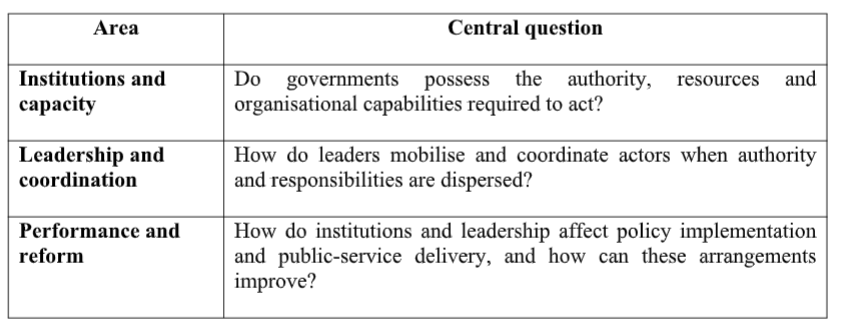
These questions are particularly pertinent in Malaysia’s federal system. A state government may often be expected to respond to a policy problem without possessing all the authority or resources required to address it independently. State-linked organisations may provide specialised capacities [7], local authorities may control particular implementation functions, and federal agencies may retain authority over other dimensions of the same problem. Effective governing therefore depends on both institutional capacity and leadership capable of coordinating actors across these boundaries.
FLAG’s Focus and Future
FLAG’s next phase will move from a broad platform for dialogue towards a more systematic programme connecting research, policy engagement and public discussion. While grounded in Penang’s experience, its work will engage with leadership and governance challenges of wider national, regional and global relevance, drawing connections between local experience and broader debates. Its work will be organised around specific governance problems and generally proceed through four connected stages:
1. Investigate: Map the institutions involved, their responsibilities and capacities, and any gaps, overlaps or constraints affecting policy implementation.
2. Convene: Bring together political leaders, administrators, practitioners and affected stakeholders to test the research findings and incorporate their experience.
3. Develop options: Identify implementable reforms, distinguishing between improvements possible within existing institutional authority and changes requiring state–federal cooperation.
4. Communicate: Translate the findings into policy briefs, research papers and institutional recommendations, while bringing selected questions into wider public discussion through FLAG Papers, Penang Institute publications and public forums.
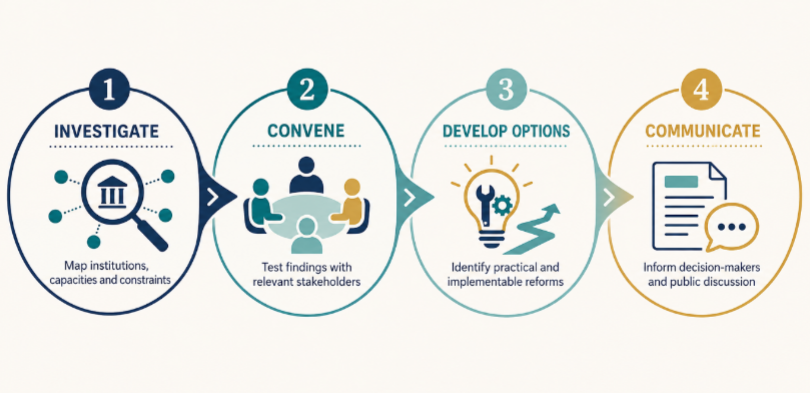
Figure 1: FLAG’s Research-to-Policy Process
The emerging project on Penang’s state-linked organisations illustrates this approach. FLAG will examine why these organisations were established, what public functions and specialised capacities they now provide, and how their roles relate to those of government departments, local authorities and federal agencies [8]. It will also consider whether their mandates, funding arrangements and accountability structures remain appropriate. The findings will inform stakeholder discussions on institutional coordination and the future positioning of these organisations before being consolidated into practical policy options.
Alongside longer-term research projects, FLAG’s South Wing Papers will provide a more responsive platform for examining contemporary policy issues in Penang and beyond through a leadership and governance lens. Rather than offering abstract commentary, the papers will connect current developments to the institutional constraints, coordination challenges and leadership choices shaping policy responses. Written for policymakers and a wider public audience, they will offer concise and grounded assessments of what governments and other actors can realistically do within existing arrangements, while identifying where institutional reform or wider cooperation may be required.
FLAG will therefore be more than a venue for events. It will provide a process through which governance problems are investigated, practitioners’ knowledge incorporated, reform options developed and findings communicated, to decision-makers and the public. By sustaining this connection between evidence, engagement and policy development, FLAG aims to help leadership and collaboration translate into more effective public action.
- Buletin Mutiara. (2023, October 17). “Penang Institute’s FLAG Initiative a Drive to Develop Leadership in the State.” https://www.buletinmutiara.com/penang-institutes-flag-initiative-a-drive-to-develop-leadership-in-the-state/ ↩
- Penang Monthly. (2019, May). “The Penang2030 Guide Is Now Out.” https://www.penangmonthly.com/emthe-penang2030-guideem-is-now-out-1/ ↩
- Penang State Government. (2026, August 17). “Authorities and Policies.” Official Portal of the Penang State Government. https://www.penang.gov.my/index.php/en/pejabat-suk/info-umum-pejabat-suk/dasar-dan-polisi ↩
- Ooi Kee Beng. (2023, October). “Raising the FLAG to Make Leadership a Common Concern.” Penang Monthly. https://www.penangmonthly.com/raising-the-flag-to-make-leadership-a-common-concern/ ↩
- This refers particularly to the emergence of opposition-led state governments following the 2008 general election, Malaysia’s first change of federal government in 2018, the collapse of the Pakatan Harapan government in 2020, and the subsequent formation of new governing coalitions, including the unity government after the 2022 general election. ↩
- Gooi Hsiao Leung. (2025). Report of the Penang State–Federal Relations Select Committee 01/25. Presented to the Penang State Legislative Assembly, 8 December 2025. ↩
- In this paper, “state-linked organisations” refers broadly to entities established, owned, funded or institutionally linked to the Penang State Government to undertake public, developmental or specialised functions outside conventional government departments. The term includes, but is not limited to, state government-linked companies, statutory bodies and specialised delivery organisations. ↩
- For an initial discussion of Penang’s use of state-linked organisations under federal, fiscal and administrative constraints, see Chan Xin Ying, “Governing Within Constraints: How Penang Builds State Capacity in a Centralised Federation”, Penang Institute ISSUES (18 August 2026) https://penanginstitute.org/publications/issues/governing-within-constraints-how-penang-builds-state-capacity-in-a-centralised-federation/ ↩
You might also like: